Posted on November 21, 2013 by shmoover
I shouted out, “Who killed the Kennedys?” When after all it was you and me. – Mick Jagger & Keith Richards
Part Two – Myth Making
Those lines make perfect poetic sense, but what do they really mean? Were the Kennedys scapegoats who died for our sins? If so, were those sins of commission or omission? Sins of deliberate evil or willful innocence? Must all mythic Kings die annually so that the land may be fertilized? Or do we Americans have such a diminished national imagination and such personal dark shadows that we simply cannot tolerate any shining individuals who prove unable to hold our projections?
Inventing Camelot
The Kennedy clan began to manipulate the media images of JFK and his immediate family long before his election and has continued to do so decades after his death. Shortly after the Cuban Missile Crisis of October 1962, JFK, fully aware of both the political moment and the mythic implications, told a historian, “If anyone’s going to kill me, it should happen now.”

Then came Camelot — a myth that there once existed a magical kingdom ruled by a wise, brave and dashing king who was unshakably devoted to his beautiful queen and their children. Born into privilege, he – like the Buddha – chose to serve truth and justice.
However, the word “Camelot” never appeared in print to describe the Kennedy years until after his death.
Only a week after the funeral, his widow put her definitive stamp on the new myth. She told Life Magazine and its thirty million readers that the President had been especially fond of the music from Camelot, the popular Broadway musical about King Arthur. He and Jackie had enjoyed listening to a recording of the title song before going to bed at night. JFK, she said, had been especially fond of the concluding couplet:
Don’t ever let it be forgot, that once there was a spot, for one brief shining moment that was Camelot.
I invite you to speak that last sentence out loud and notice if some unidentifiable emotion washes over you.


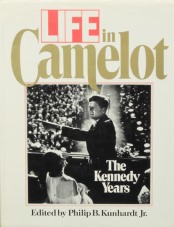
Jackie was determined to convince the nation that her husband’s presidency was a unique and magical moment, and one that was now forever lost. “There will be great presidents again,” she said, “but there will never be another Camelot.” JFK, as his widow wanted him to be remembered, was The King – a peacemaker, like King Arthur, who died in a campaign to pacify the warring factions of mankind. The Camelot myth of the 1960s was born, a retelling of the earlier myth.
But the Camelot image as applied to the Kennedy presidency had some unfortunate and unforeseen consequences, writes James Piereson:
By turning President Kennedy into a liberal idealist (which he was not) and a near legendary figure, Mrs. Kennedy inadvertently contributed to the unwinding of the tradition of American liberalism…The images she advanced had a double effect: first, to establish Kennedy as a transcendent political figure far superior to any contemporary rival; and, second, to highlight what the nation had lost when he was killed. The two elements were mirror images of one another. The Camelot myth magnified the sense of loss felt as a consequence of Kennedy’s death and the dashing of liberal hopes and possibilities…the best of times were now in the past and could not be recovered…The Camelot myth posed a challenge to the liberal idea of history as a progressive enterprise, always moving forward despite setbacks here and there toward the elusive goal of perfecting the American experiment in self-government. Mrs. Kennedy’s image fostered nostalgia for the past in the belief that the Kennedy administration represented a peak of achievement that could not be duplicated.
Millions of baby-boomers date their initial disillusionment and loss of idealism – their loss of innocence – from this point. To them, democracy died along with the President. The assassination was, plainly and simply, a military coup, and since then elites in media and government have colluded in maintaining the con: a veneer of legitimate, democratic process. Sociologist Linda Brigance wrote that without their heroic king, Americans began to feel a
…paradoxical combination of romantic yearning and fatalistic inevitability… (that) set the stage for the political cynicism and civic disengagement that characterized post-assassination America.
A few years later, Americans began and have continued to maintain one of the lowest levels of voter participation in the industrialized world, with typical voting levels of 50% in presidential elections. Consider for example the “Reagan revolution” of 1980 that the pundits tell us ushered in a great swing to the right in political opinion. It actually was propelled by just over 50% of the vote count, or about 26% of potential voters. This was a lower percentage than Adolph Hitler won in 1932.
The characteristically American myth of unending Progress suffered a terrible blow. The assassination, writes Charles Eisenstein,
…is like a radioactive pellet lodged inside the body politic, generating an endlessly metastasizing cancer that no one has been able to trace to its source. (It) opened a gulf between people and government that no bridge can span. It was the death of America – the America of a government “of the people, by the people, and for the people.” People and government are now separate.
Since that time, half of American adults have withdrawn from civic involvement, more or less permanently. Countless others, influenced by unrelenting media barrages, still seem to be able to resurrect their sense of innocence after each political outrage or school shooting. “We’re better than that,” they say. May it be so.
The mythmaking Industry
In the age of the Internet, the mythmaking (and the anti-mythmaking, which is its mirror opposite) have grown into industries.
It has continued on both the right (Kennedy, they say, was more militaristic, more corrupt, more conservative and accomplished far less than Richard Nixon) and the left (Kennedy, they say, was murdered because he was intent on withdrawing from Viet Nam). Consider the ongoing controversy of his National Security Memorandum # 263. James Galbraith argues that Kennedy’s intention to withdraw after the 1964 election, articulated on October 11, 1963, was “…the formal policy of the United States government on the day he died.” And we also note that Lyndon Johnson’s NSAM 273, which authorized planning to begin for graduated offensive operations against North Vietnam, was issued on November 26th, only four days after the assassination.
Back and forth they go, to this day. Gore Vidal, a ruling class insider turned critic who knew Kennedy well, said:
And it is now part of the Kennedy legend, that had he lived, this war would not have taken place…or would not have escalated. I can promise you…that he would have been as deeply in it as (Lyndon) Johnson…I liked him tremendously, and I hang his picture in my library, not as an icon, not as a memory of Camelot, not as a memory of glorious nights at the White House or in Bel-Air; but never again to be taken in by anybody’s charm. He was one of the most charming men I’ve ever known, one of the most intelligent, and one of the most disastrous presidents I think we’ve ever had.
Vidal made that last statement long before the age of Bush / Obama / Trumpus, so we must put it context. But it does have bearing on how we consume our myths.
Conspiracy
Here we encounter another aspect of American history and culture that has taken on a mythic function, what I call gatekeeping, or the conspiracy of the center. It’s a huge topic that I address here, but it boils down to this. In Campbell’s terms, one of the four functions of mythology is the sociological function, which works to support and validate the existing social order and bind the individual to the society, its rulers and its alleged purposes.
In the tribal experience, the world of real initiation ritual, this function was entirely appropriate. But in our demythologized world of mass, urban civilization the sociological function of myth is to support nothing other than consumerism, nationalism and (in America) the stories of exceptionalism and manifest destiny that justify a world-wide empire and military-industrial complex.
Those intellectuals who, cynically or naively, enforce the conformist thinking that binds most citizens into the “reasonable center” are the gatekeepers of the culture. Whereas this function was once the duty of the priesthood, now it is the educational system (especially historians) and the media who carry it on.
This of course brings us to the issue of fake news. But for now, all we need to know is that for at least seventy years (or well over one hundred, if we consider official pro-war propaganda during World War One), the National Security State has controlled much of what the mainstream media has had to say, with agents embedded in literally hundreds of media outlets. I don’t have the space here to convince you of this, but I encourage you to do your own research. You can find a large number of references here or here. Or you could begin with Edward S. Herman’s essay, Fake News on Russia and Other Official Enemies: The New York Times, 1917–2017.
Since the end of World War Two, gatekeepers of all political persuasions have served – on a daily basis – to remind most middle-class white people of just exactly who or what is outside the pale of acceptable discourse. And one of the main tools at their disposal has been false equivalency: lumping loonies such as Obama “birthers” in the same sentences as those who question accepted political narratives such as the Kennedy assassinations and 9-11. Consciously or not, such voices offer a very tempting proposal: if only we were to turn off our cynical (or logical) minds, we could be accepted into the brotherhood of the reasonable center. We would be within the pale. We would (accurately or not) know who we are, and we would clearly identify those outside the pale.
We can understand liberal mythmaking about JFK in the context of lost innocence and longing for the return of the King. But a careful look at media articles around the 50th anniversary of the assassination reveals that the great majority of them continued to take the official narrative for granted and used various subtle means of demonizing critics..
By the way, it isn’t even the official narrative anymore, and hasn’t been since 1978. That year, the House of Representatives Select Committee on Assassinations found that in addition to Oswald, there likely was a second gunman. The commission concluded that the shooters were part of a “conspiracy,” without determining exactly who was behind it. And, speaking of official narratives, few realize that in a 1999 civil lawsuit in Memphis, a jury reached a unanimous verdict that Martin Luther King, Jr. was assassinated as a result of a conspiracy. That you probably don’t know that is a testament to the power of the mass media, which can marginalize dissent, either by demonizing or, in this case, by simply ignoring it.
But let’s get back to Kennedy: History professor and gatekeeper Steven Gillon dismisses both the House report and Oliver Stone’s movie by inserting simple but patronizing modifiers into his text:
…the House Committee came to the bizarre conclusion that there was a second shooter on the grassy knoll, and that shooter fired at the President, but missed…In 1991, filmmaker Oliver Stone tapped into these doubts, and added his own paranoid twist, to create the popular movie, JFK (my italics).
The gatekeepers have their assignment, self-imposed or not, and it hasn’t changed for decades. It is essential to the myth of American innocence that a so-called “troubled individual” killed Kennedy. The Lone Gunman has become another stock character in American myth, evoked whenever a mass shooting occurs – and, following it, every time, some pundit is sure to bloviate that “we’ve lost our innocence.” The stereotypical Lone Gunman functions very specifically to divert our attention from the mass violence that we perpetrate daily upon the Third Word and upon our own children. He is a fundamental cog in the establishment – and regular re-establishment – of our sense of innocence.
Ironically, the Lone Gunman is the mirror opposite of the Western Hero, who, in dozens of movies) defeats the villains by himself, without the aid of the citizenry. High Noon is the classic example. Both of these Lone Gunmen, one directly and one in reverse, symbolize and teach our foundational value of American rugged individualism – and, equally foundational – the resolution of disputes through extreme violence.
This is one reason why the gatekeepers continue to marginalize the “conspiracy buffs.” But even one of those gatekeepers – NBC News (10/2917) – admits:
Search data going back all the way to 2004 indicate that interest in the topic (the Kennedy assassination) surpasses interest in more recent political events including the Watergate scandal and President Bill Clinton’s impeachment.
The implications are quite significant. If indeed Lee Harvey Oswald didn’t act alone, if in fact a wide-ranging military-industrial-organized crime conspiracy was responsible for Kennedy’s death, if the C.I.A. murdered him (as 62% of us still believed as recently as 2013) – then America is not exceptional, no different, no freer, no better than any other nation. And if we call that idea into question, then the whole, monolithic edifice of American innocence (empire, capitalism, masculinity, misogyny and white privilege, not to mention freedom and opportunity) come up for review, as they did by the late 1960s.
In mythological terms, Dionysus causes cracks in the great walls of Thebes, and all the repressed parts of the psyche, all of the un-grieved ghosts of the past come roaring into the city, intent on revenge.
Peter Gabel wrote about the trauma that the nation experienced:
But the real trauma, if we move beyond the abstraction of “the nation,” was the sudden, violent loss for millions of people of the part of themselves that had been opened up, or had begun to open up during Kennedy’s presidency…In order to contain the desire released by the Kennedy presidency and the sense of loss and sudden disintegration caused by the assassination, government officials had to create a process that would rapidly “prove” – to the satisfaction of people’s emotions – that the assassination and loss were the result of socially innocent causes… the lone gunman theory…isolates the evil source of the experience in one antisocial individual, and leaves the image of society as a whole…untarnished and still “good.”…(It)…reinstitutes the legitimacy of existing social and political authority as a whole because it silently conveys the idea that our elected officials and the organs of government, among them the CIA and the FBI, share our innocence and continue to express our democratic will.
But from a larger psychosocial point of view, the effect was to begin to close up the link between desire and politics that Kennedy had partially elicited, and at the same time to impose a new repression of our painful feelings of isolation and disconnection beneath the facade of our reconstituted but imaginary political unity…The interest we share with the mainstream media and with government and corporate elites is to maintain, through a kind of unconscious collusion, the alienated structures of power and social identity that protect us from having to risk emerging from our sealed cubicles and allowing our fragile longing for true community to become a public force.
In 1967 the CIA coined a new phrase in response to widespread skepticism of the Warren Commission. It sent out specific instructions for “countering and discrediting the claims of the conspiracy theorists” (my italics). The Agency recommended using assets such as “friendly elite contacts (especially politicians and editors)” who could be provided with ready-made talking points. Since then, as I mentioned above, gatekeepers throughout academia and the major media have lumped together all critics of the dominant narratives of American history under this phrase.
Here are two recent links to further commentary on the issue of media gatekeeping.
The Obama administration (like all that followed Johnson’s) continued to give ammunition to those who question the dominant narrative. In 2010, a federal archivist stated that only about one percent of the five million pages of government files on the assassination had been withheld from public view. But that amounted to some 50,000 pages, and Obama did nothing to facilitate that process. In October 2017, Trumpus announced that he had ordered all the remaining files to be released. As usual, he was taking credit for legislation mandating the release that had been passed in 1992. But very quickly and very publically, the CIA disagreed (with extreme prejudice, one might say), and Trumpus, whatever his actual motives, caved in. Mainstream media gatekeepers typically noted that 2,800 documents had been released and 300 remain withheld. However, writes Rex Bradford, “They are off by a factor of 100.”
In fact, tens of thousands of documents…remain sealed at the National Archives…This includes 3,147 “withheld in full” records never seen, and an unknown number of redacted documents estimated at about 30,000. Intensely lobbied by federal agencies including the CIA, Trump instead authorized the withholding of well over 90% of these documents. 52 of the 3,147 withheld-in-full records were released and put online by NARA, less than 2%, and 2,839 of the redacted documents were released, which is probably less than 10% of that set.
“The biggest revelation from last week’s limited release of the JFK files,” writes Caitlin Johnstone, “is the fact that the FBI and CIA still desperately need to keep secrets about something that happened 54 years ago.”
Former high-ranking CIA man Ray McGovern writes:
…occasionally the reality of how power works pokes through in some unguarded remark by a Washington insider, someone like Sen. Chuck Schumer, D-New York…he also is an ex officio member of the Senate Intelligence Committee…with MSNBC’S Rachel Maddow, Schumer (said) “Let me tell you, you take on the intelligence community, they have six ways from Sunday at getting back at you. So even for a practical, supposedly hard-nosed businessman, he’s being really dumb to do this.” So, President Trump has been in office long enough to have learned how the game is played and the “six ways from Sunday” that the intelligence community has for “getting back at you.” He appears to be as intimidated as was President Obama.
In October of 2021, 58 years after the event, Joe Biden postponed the full release of the files. In November of 2022 (30 years after JFK), Oliver Stone released his film JFK Revisited: Through the Looking Glass. Quite predictably, it provoked the usual howls of derision, with the once-progressive Rolling Stone calling him a “tinfoil-hatted fabricator”.
But the gatekeepers have never been able to close their case, because we are dealing with the powerful psychological issue of projection, and its opposite, disillusionment. Eisenstein writes:
Many present-day conspiracy theories embed the Kennedy assassinations within a larger mythology; it is an integral structural element. That doesn’t mean that the truth of a particular Kennedy conspiracy theory entails the truth of any of these larger conspiracy theories. It does mean that without the JFK assassination and cover-up, most of these other theories would not have been born…Certainly most are objectively false…but also they are all true in their basic motif. They give voice to a profound alienation, an endemic and well-deserved distrust of authority. Today huge numbers of people believe the election was stolen, that the vaccines are a deliberate depopulation scheme, even that the moon landing was fake…The monstrous act of deception that was November 22, 1963 makes all of these a lot more plausible, suggesting, “They are capable of anything.”
(That “anything” even includes the notion that JFK Junior is still alive and is a beacon to the QAnon crowd. But their perspective contains an internal logic: If the Deep State killed his father and the government has lied about it all these years, then what else are they lying about?)
From a mythic perspective, however, the entire assassination dispute addresses a rather superficial question – did they or didn’t they? We need to go deeper and consider how the ongoing mystery surrounding Kennedy and his death reflects much deeper, archetypal mysteries about his – and our – lives.




 Barry Spector's Blog


