Categories
Uncategorized

Barry’s Blog # 341: A Mythologist Looks at the 2020 Election, Part Two

Here’s another mystery. What does it say about the public’s appreciation of the Democratic Party that, with the most profoundly unpopular and deeply reviled president in U.S. history, it took a pandemic with 140,000 dead and an economic depression with forty million unemployed to finally push Biden’s poll numbers past those of Trumpus? Here’s another one: Michael Bloomberg spent nearly a billion dollars convincing you that Bernie Sanders was unelectable. Can you imagine the good that money would have done had he spent it fighting voter suppression? Have you heard a word about him since he dropped out?

Here’s another one: Do the Democrats really think they can win with a candidate who has no constituency, no charisma and few platform positions that would attract more voters other than not being Trumpus? Do they really care about winning?  Does Joe Biden really care about being President (see below)?

I hope I’m wrong. May the future bring us something better than this. We deserve better, or so we’d like to think. But here I want to present some mythological and psychological speculations.

What exactly are these two old white guys contending for? Liberals lament that the system is dysfunctional or broken, while radicals will argue that it has been doing quite well in terms of its actual functions of maintaining the military empire abroad and redistributing wealth upwards at home. As a mythologist, I see both points of view, and I suggest that the myth of American innocence holds it all together.

One aspect of what Joseph Campbell called our demythologized world, especially in America, is that the distinctions between religion, politics and entertainment have collapsed (this week Trumpus sat at the Oval Office desk and endorsed a brand of beans. You can’t make this stuff up). trump-beansThis is perhaps because all three of these areas of public life are the realm of the con man’s main interests: making money and aggrandizing the self. For more on this American archetype, read my essay The Con-Man.

Please understand that anything spoken (well, nearly anything; see below) for the public by anyone at that level of power has been carefully vetted in front of multiple focus groups and edited precisely to fit the perceived needs of a very specific audience so as to manipulate its views of the politician. If in the Age of Trumpus (or for the past several election cycles) you haven’t noticed this, you haven’t been paying attention. But it began long before this particular con man entered the White House. I have written much more on these issues in these essays:

Let’s Talk About Me

Obama and the Myth of Innocence

Obama’s Tears

The Ritual of the Presidential Debates 

Stories We Tell Ourselves About Barack Obama 

The Presidential Dilemma

Trumpus and Biden (and everyone around them, including the entire press corps) know very well that every American president since Harry Truman, and arguably for much longer, has been  essentially a spokesperson for interests far more powerful than he; a “master of ceremonies” in the lesser sense; a salesman for the myth and the empire. He certainly is not its ruler, not even the primary “decider,” as G.W. Bush described himself.

I also want to suggest that all contenders for the Presidency in the United States, far more than in any other country, are well aware of a particularly complex role they will be called upon to play,  which they have been practicing for their entire adult lives (quite literally, in the case of Joe Biden). They will face a unique political dilemma created by two conditions.

The first is the capitalist domination of politics, which require a spokesperson to direct the national narratives toward the grand aims of the military-industrial-petrochemical-pharmaceutical-carceral complex. The second is his symbolic role. As head of state, he must embody the mythic figure of the King for his people. And these two conditions require that he play two opposite aspects of the myth of innocence against each other.

As spokesman for the Empire, he must continue at all times to amplify the national mood of paranoia and fear of “the Other” so as to justify a continuing national military state and repression of people of color at home. In other words, he must manipulate the traditional white American sense of being the innocent victim, or at least the potential victim, of some dark (and dark-skinned), irrational, violent, predatory outsider.

This of course would be nothing new to him, since anyone even aspiring to his office, not to mention those actually vetted, would be perfectly aware of it. And to be sufficiently convincing, he must, in a sense, play the victim himself, so that his followers can identify with him.

As King-figure, however, his job is to absorb the idealistic projections of millions of people. I write “absorb” because in myth this is a two-way process. The Sacred King takes in our projections and hopes and then radiates them back out as fertility, as abundance, as blessing. (Not to do that is simply to suck those dreams in like a black hole of narcissism and give nothing back. This has been Trumpus’ game for decades, and perhaps the consequences are finally catching up to him.)

Any person who assumes the presidency automatically takes on this public projection. At the level of image, metaphor and deep narrative, these men are the nation because they embody it, and the nation must endure. Why must the nation endure? In this demythologized world authentic myth and ritual have disappeared, and they have been replaced by consumerism, fundamentalism, substance abuse – and nationalism, in which the individual identifies completely with the state, and is willing to sacrifice its young to its aims.

Here we have to take a detour through what I consider to be one of the most important books ever written, Blood Sacrifice and the Nation, by Carolyn Marvin and David W. Ingle.  It is summarized in a short article here. And I wrote of it here:

…“nationalism”…for the past 150 years has supplanted mass religion in most advanced countries. But it retains much religious symbolism. The familiar Christian God has long been replaced by the group, which is symbolized in the totem fetish – the flag. A fundamental aspect of America’s civil religion is our unique cult of the flag. Curiously, we display it in our churches as well as in many places of business, as if to reinforce the notion that in America there is little difference between them. We worship it by pledging allegiance, and occasionally by kneeling and kissing it. And we are horrified at the thought of its desecration, because, they write, it is “the ritual instrument of group cohesion…the god of nationalism.” Such rituals nearly equate God with America, writes Robert Bellah. Often “…the most jingoistic identity of nation and church has come not from our political leaders but from the churches themselves.” And the flag is embodied in the totem leader, the President.

In this view, the purpose of ritual at the level of the large, national state is to sustain the group by repeating, at various levels of intensity, the act of group creation. Participants in such rituals – especially in our culture of radical individualism – achieve a kind of communion and learn that their God demands human sacrifice. Not the sacrifice of the defeated, which implies the preparedness to kill for one’s country, but willing sacrifice, the willingness to die for it. Or at the very least, the willingness to send one’s children – the best of the best – to die for it.

Body sacrifice lies at the core of nationalism. Warfare is the most powerful enactment of the ritual of blood sacrifice…The creation of sentiments strong enough to hold the group together periodically requires the death of a significant portion of its members. In short, society depends upon the death of sacrificial victims at the hands of the group.

We, dear readers, are the group. Well, not really, since our children won’t be among the sacrificed, those who will die for capitalism. But in the broader sense, who could argue that our generation has not condemned them all to a collapsing ecosystem and polluted bodies?

In a twisted sense, there is some good news here. The fact that so few of us are willing to soil ourselves by voting actually indicates that very large numbers of us (not including conventional liberals) can see through the ritual charade. The bad news, well…not voting gave us Trumpus.

Back to the presidential dilemma. Another consequence of the loss of myth is that we have conflated two archetypes, the King and the Warrior, who is in service to the King. In doing so, we minimize the creative potential of each of them. This Warrior-King must continually re-affirm the fantasy that his intentions (and ours) are noble, protective and altruistic, that America is truly exceptional, that America has a divine mission to save the world and will always prevail.

And to do that, he must play the exact opposite of the victim, the Hero (the immature form of what Jungian writer Robert Moore called the Warrior archetype)  He must reassure us of his – and our – ability to meet all threat and defeat them, while simultaneously bringing the Good Word of our Christian compassion to those evil ones who would – for no apparent reason – harm us. As Bush endlessly repeated after 9/11/2001, it is absolutely certain that America will prevail against the external Other (formerly the Native Americans, then Mexicans, then Communism, now Islamic terrorism, which is shifting before our eyes into “the Russians” and “the Chinese”), because the nation, which he embodies, is charged with the divine mission of defeating evil and spreading freedom and opportunity. Not to do so would be to call our most basic national and personal identities into question.

He must simultaneously and repeatedly tell us, be afraid, be very afraid – and – we are absolutely unconquerable! He must prove to be a professional storyteller of the double-bind, conflicting messages that some psychologists consider to be the genesis of schizophrenia. And after many generations of hearing and ingesting these crazy-making narratives, it really is a sad commentary on all of us that we have come to expect nothing better from our leaders.

The media gatekeepers face an even more complicated dilemma. As fascism threatens to descend upon us, liberal America has been attempting to walk a fine line: alternately normalizing and de-legitimizing the Trumpus regime, especially since this spring, while carefully refusing to examine any of the bedrock assumptions of our myth of innocence.

For the sense of “nation,” with all its white privilege, economic disparities and permanent warfare to endure, the media must continually try to shore up each new crack in the veneer of American innocence. So controlling the narratives and manipulating our perception of really terrible people is one of the primary functions of our media gatekeepers. The classic analysis of the media’s gatekeeping role is Noam Chomsky’s article, “A Propaganda Model.” 

Bush_Michelle_Obama_BlissOne of the ways they do this is by re-habilitating the reputations of previous presidents, such as Bush and his father.  In this context, it really shouldn’t be surprising that Bill Clinton eulogized Richard Nixon, that Barack Obama lavishly praised Ronald Reagan, RT_hillary_clinton_and_henry_kissinger_3a_ml_160518_4x3_992that Hillary Clinton is a close friend of the war criminal Henry Kissinger, or that even Trumpus should be granted an insane sort of normalization. 

War criminals. I don’t want to belabor this point, but it is critical to understand what the people we vote for – all of them – are willing to do in order to prove their loyalty to the power brokers. As Chomsky has said, “If the Nuremberg laws were applied, then every post-war American president would have been hanged.”hqdefault

It is equally important to understand how those same oligarchs require the same proof of loyalty from the media gatekeepers, who have responded by creating a mainstream consensus that the madness of normal life is normal. This is the “normal” to which Biden promises he will return us.

So it is useless and counter-productive to criticize Trumpus as merely a negative, even terrible exception to the story of American exceptionalism, or even as someone who has corrupted this story. There is nothing to be gained by arguing, for instance, that he is dangerous, incapable, racist, misogynist, stupid or unpatriotic because he won’t listen to the “intelligence community” — as if progressive-minded people have any business aligning themselves with the murderers and regime-changers of the CIA. 

Here is another aspect of our diminished American reality: if the CIA “leaks” any “alleged” information about “events” anywhere in the world, they are doing so because they want you to consume a narrative of their own construction, to serve the long-term aims of the American empire. In 2020, from Russia to China to Syria to Israel / Palestine to Afghanistan to Venezuela, and sometimes even Iran and North Korea, most leading Democratic politicians have been criticizing Trumpus from the rightAnd this bizarre truth takes us a long way into the mystery of how they shamelessly stole the nomination from Bernie Sanders, as we’ll see in Part Three.

Categories
Uncategorized

Barry’s Blog # 340: A Mythologist Looks at the 2020 Election, Part One

The war is not meant to be won; it is meant to be continuous. – George Orwell

Watch what we do, not what we say. – John Mitchell, Attorney General under Richard Nixon

Let me be perfectly clear (Nixon said that). I want Biden to win in a landslide, win back the Senate, pick the next few Supreme Court Justices and send Trumpus (Trump = us) out beyond the safety of presidential immunity, where he can get prosecuted for at least some of his crimes. However, for me (in California) and most of you who live in reliably red or blue states, our votes are meaningless. If your passion remains strong, then work for him in the small number of states other than your own that will actually be in play, or work for local progressive candidates.

First, the good news. In many ways this is a time of profound hope. As mythologists, we believe nothing, but we entertain possibilities. White people are reading about privilege and fragility and waking up. Some cities are reducing their police budgets and firing some of their worst racist police officers. Confederate statues are coming down. Sports teams are dropping their racist names. The legal system is recognizing Native American rights and ordering oil pipelines on native land to shut down. The entire oil industry may be collapsing. The next vice president might even be a woman of color! This didn’t happen overnight. As Rebecca Solnit writes, it takes “Decades of Activism That Leads to Historic Change.”

Indeed, when we view these times from a mythological perspective, we see, despite the suffering, much to be excited about.  The combination of the pandemic, the reaction to George Floyd’s murder and cumulative, national disgust with Trumpus have thrown the collective consciousness into such a (welcome) frenzy that, for the first time since late 2001, and perhaps for the first time since the 1960’s, major cracks have begun to appear in the façade of the myth of American innocence.

And the optimism, however, brings its own version of that innocence, as if everything had been fine before Trumpus, as if his removal is assured, as if simply replacing him with Joe Biden would be the answer to all of our problems.

The liberal news media tell us daily how he is falling behind in the battleground states. It’s all good.  One writer goes so far as to predict “a Democratic tsunami.” Another tells us that “Trump is accelerating a political realignment that would have otherwise taken decades.”

Now the bad news: none of them are addressing the elephant in the living room.elephant-living-room1

That’s a phrase that is commonly used in addiction recovery, and it seems particularly relevant to use it when reminding ourselves of our national addictions. Of course, from any rational, political-science perspective, the idea that Trumpus seems to be making the wrong decisions on a daily basis, that he’s doing everything possible to alienate voters seems obvious. He almost seems to want to lose (see below) – unless, like four years ago, his people know something we don’t.

Refusal to address this particular elephant is a mythological issue, because all this optimism, all this denial, all this obsession with blaming Trumpus for all of our ills, all this unwillingness to confront deeper issues is happening within the broader context of the myth of American innocence, just as it did then. Indeed, on Election Day 2016, the Cook Political Report (“Democratic tsunami”) predicted the same thing, as did all the major polls. As I wrote in my analysis of the election,

Damn the conventional wisdom. We may well find the answer in pursuing this question: Why, despite the polls favoring Clinton, did the vast majority of high-rolling, last-minute gamblers bet on Trump?…Yes, this was reported in the mainstream media (MSM), but no one seems to have paid it much attention, except for other gamblers. Before you cast the conspiracy theory hood over me (the conventional means of shutting down discussions), shouldn’t we ask what these pros knew?

This election may not go any differently from the 2016 election, and for most of the same reasons that I wrote about in that essay. It’s very likely that Biden will win a large majority of the popular vote, and probably by even greater numbers than Clinton did.

But this is reality: massive purges of voters (a federal judge recently backed Georgia’s purge of more than 100,000 voters); gerrymandering; challenges to the right to vote; voter ID requirements (36 states now have voter ID laws); early/absentee voting restrictions, including cutting hours or days of voting; restrictions on voting registration drives by third-party organizations (such as those enacted in Tennessee that impose civil penalties on canvassers that submit incomplete or inaccurate registration forms); Covid-related fear of in-person voting and budget cuts; likely restrictions on voting by mail; the hesitancy of most states to use ranked-choice voting; a tsunami of polling site closures; and possible defunding of the Postal Service itself (more on that here).image3-2-700x470

Any combination of these factors could very well give the Republicans another Electoral College victory. For a summary of all this fraud, legal or otherwise, and to read the one person who is most in touch with its reality, follow Greg Palast.

Yes, Biden has a big lead in mid-July. But some polls had Clinton ahead by double digits as late as October 23rd, 2016.  This is not to call polls into question; those polls were probably quite accurate – in that they measured how people expected to vote, and quite likely how they did vote. They did not measure whether those votes were counted accurately. And the fact that the mainstream media has had almost nothing to say about this massive crime can mean only a few things:

1 – In their staunch innocence, they simply don’t believe that American politicians can be so corrupt.

2 – They uniformly chose and continue to choose not to inform the public.

And there’s plenty of speculation about how Trumpus, even if he loses, might try to remain in office.

I don’t have much regard for the Democrats, but there is no doubt whatsoever that the Republican Party is comprised entirely of career criminals, con men and outright sociopaths.

Republican governors and secretaries of state ruthlessly, absolutely control the entire election process, including registration and access to voting, in 26 of the 50 states. These are the people whose operatives actually “count” the votes, and we can assume that they will do everything possible, legal or illegal, to influence the results, exactly as they did four years ago. At least since the 2000 election, the baseline of American democracy has been massive computer fraud. Here is reality, as I wrote (and absolutely nothing has changed):

We can never know how many people went into booths in those states, voted for Clinton on electronic machines, left the building and told a professional poll taker whom they’d voted for, but whose vote, unknown to them, was then flipped…Clinton’s Florida lead in exit polls was 1.3% but she lost by 1.3%, a 2.6% shift. In North Carolina her exit poll margin was 2.1%, but the final vote count showed Trump with a 3.8% lead. She had a 4.4% exit poll lead in Pennsylvania, but she lost by 1.2%, a 5.6% shift. The North Carolina and Pennsylvania shifts – 5.6% – are way outside the margin of error and therefore very unlikely to occur by chance. Altogether, exit polls were conducted in 28 states. In 23 of them the discrepancies between the exit polls and the vote count favored Trump. In 13 of them those discrepancies exceeded the margin of error.  

For those who were willing to peek beyond the veil of denial, almost all of these tactics were on full display during this June’s primaries, which Palast has called “Trump’s Vote-Heist Dress Rehearsal.”

…what the press calls the “meltdown” in Georgia (and in the Wisconsin and Kentucky primaries) was very much a dress rehearsal for the plan for minority voting hell in November, not only in Georgia but in a slew of other GOP-controlled swing states…According to an MIT study, a breathtaking 22% of all mail-in ballots are never counted…some states are simply refusing absentee ballots to hundreds of thousands of registrants—or, not sending cards that allow the voter to ask for the mail-in ballot…Georgia is one of the GOP’s ballot-refusing champs. The state refused to send mail-in ballot requests to over a quarter million voters on their so-called “inactive” voter list…In 2018, Georgia purged, that is, erased the registrations of, over half a million citizens on the grounds they’d left Georgia or moved from their home county…(but) 340,134 Georgia “movers” who lost their vote had, in fact, never moved from their registration address.

Trumpus himself has acknowledged that if the system were to be reformed,

The things they had in there were crazy. They had things, levels of voting that if you’d ever agreed to it, you’d never have a Republican elected in this country again.

But before you get on your “blame the GOP for everything” horse, remember to thank the Obama administration for expanding the national security state. We are on a razor’s edge. Russell Dobular writes:

Right now there are still too many functioning vestiges of divided government for Trump to make full use of the terrifying powers we’ve imparted to the state since 9/11, but one major terrorist attack on US soil, or the outbreak of a serious war, and it’s only a short step to indefinite detention for activists and opponents of the regime, many of whom will be the same liberals who cheered the arrest of Julian Assange and want to see Edward Snowden put on trial. And thanks to the Patriot Act, which Congress quietly renewed last week,  as long as the government labels the detainees “terrorists,” it will all be perfectly legal.

So let’s not be naïve. Naiveté, along with overconfidence and deep fear, are the fundamental positions of American myth, and we simply no longer have the luxury of indulging in them.

This culture has vomited Trumpus up to be our symbolic King. But he did not cause any of our problems. He simply embodies them and mirrors them back for all of us. Trumpus is us, and as long as we do not collectively admit that our refusal to confront our racist and violent national character, we deserve him.

Read Part Two here. 

Categories
Uncategorized

Barry’s Blog # 243: Between the Worlds

11:00 A.M. – I leave Sebastopol in a good mood, after a wonderful poetry salon the previous evening, followed by a great breakfast with close friends. I have plenty of time to attend to today’s projects: get home, check the chickens, clean up, review the poems I might want to recite this evening during my KPFA interview about our upcoming Rumi’s Caravan (www.rumiscaravan.com) performance, meet another friend for coffee at 3:00, go to the Finnish Hall in Berkeley, park the car and leave posters for the Noah Project evening event, then walk up University Ave to the radio interview, then walk back to the Finnish Hall for singing with the Noah Project. Finally, get home to babysit the girls while Alex goes to pick Emily up at the airport. Traffic is slow, and I spend the drive going over my poems (first mistake).

12:00 P.M. – The car loses power on the Richmond-San Rafael Bridge and I drift over to the breakdown lane. I call 9-11. rich-788x563

12:15 – The emergency driver shows up and pushes my car up the incline of the bridge and down to the large turn out near the East toll plaza. He tells me that now I can contact AAA and they will tow me where I need to go. It’s all good, except that now I have time to worry about what caused the engine to stop, and to observe the ominous “check engine” light.

12:30 – I call AAA. They tell me that a truck will be dispatched shortly. I marvel at the technologically enhanced privilege of possessing a smart phone with GPS and AAA membership on a beautiful Sunday. It’s all good.

12:50 – The AAA driver calls and tells me that he is not allowed to operate on the bridge, that I have to call 9-11 / CHP back. I tell him that I’m not on the bridge, but on a large turnout with several parked construction vehicles and lots of room for the tow truck, next to a large, yellow storage container. But no…Got to call 9-11.

download 12:55 – I call CHP and plead for help. The dispatcher relents and tells me that CHP will call AAA and give them permission to tow me from the spot. AAA sends me a text announcing that they’ve got me covered, that I can click a certain code on my phone to get more information. I do, and I hear a recording that I’ve called a wrong number. Twice, just to be sure.

It begins to occur to me that I am in neither of two jurisdictions, neither CHP nor AAA, in a parking area that is neither freeway nor not freeway, neither West Bay nor East Bay. I have been cast into a space between worlds. I’m on a bridge, for Chistsakes, a universal image of liminality. I’m ridiculously close to (yet separated by three lanes of fast traffic from) the toll plaza, the ritual entrance to the space between worlds, where one has to give three coins to the ferryman before entering the world of Hermes, god of travellers. I consider the bike accident I had a week ago. Have I been watching where I’ve been going? The metaphors are piling up like the recycled metal in the huge bin next to my car. It’s time to start writing this bizarre history down. I receive no further calls or texts. What to do? Recite more poems and gaze out at the bay.

1:45 – I call AAA for an update. Each time I do so I must endure a lengthy voice message system, followed by a recording: “We are experiencing a very busy day and your expected wait time to speak to an operator is 5-10 minutes”. When they finally answer, they know nothing about my situation and have no record of my previous call. CHP has not notified them. I have to re-start the whole conversation (and give them my 16-digit ID number yet again), telling them, once again, that I’m on the eastbound turnout, barely 100 yards from the toll plaza. They’ll call back with ETA. They send me another text with a link to a map and my position, which is described as at “Railroad Avenue” (a street somewhere near the bridge exit but not even close to where I am). What to do? Walk around, recite more poems.

2:30 – I call my friend and break our coffee date. I call AAA again, go through the whole frustrating procedure again. After another long wait they tell me that the truck is in San Rafael, heading toward me. I get a second text with another code link to another “wrong number” recording. Twice, just to be sure.

2:45 – I see a tow truck turning from the parking area between the east and west lanes (between worlds) fifty yards to the east of me and disappear eastward, away from me. I begin to wonder what other dates I might have to cancel.

3:10 – A tow driver calls me from a very noisy vehicle, asking if I’m at Railroad Avenue. The call breaks up. The web map indicates that both he and I are in the westbound lane. I return his call twice, leaving two messages but get no response. He answers my third call. I repeat all the specifics of my location. He says now he knows where I am.

3:15 – I call him again. He says he’ll be there in two minutes.

3:30 – He arrives. It’s the same tow truck that had passed fifty yards from me 45 minutes earlier. But I’m relieved. We’re making progress.

3:45 – We’re headed toward Oakland. Inbound Sunday traffic slows to a crawl immediately, even though we’re barely in Richmond. The crawl will last all the way past Berkeley. From the right-side seat, I gaze out at the bay, alternately cursing my life and giggling at the looniness of this unfolding karma drama.

4:00 – Someone cuts us off, forcing my driver to slam his brakes. We share stories of truck driving adventures (I used to run a furniture-moving business), how all day long I used to, and he does, save other drivers from the consequences of their stupid driving. And they don’t even realize it.

4:15 – Approaching the 880 / 580 split, he’s still in the inside lane. I ask him if he knows where I need to bring the car. He says that he does. I remind him to stay on 580 East, not 880. He takes 880. We get off at Grand Ave. and go through West Oakland toward the Temescal neighborhood, where my mechanic is. No problem, except that now we’ve lost more time. I make notes about exactly what I need to accomplish when and if I get home: shower, collect Rumi’s Caravan posters, etc. And eat. I haven’t had lunch. Forget the chickens.

5:15 – We arrive. He unloads the car in my mechanic’s lot and then turns on my engine. Good news: I had run out of gas. Bad news: I’m an idiot, or at least reciting poems in my mind while driving had put me into a trance (again, between worlds), and not for the first time. He says goodbye, refusing my tip offer. Nice guy. It could have been different.

5:30 – I march double-time toward home, figuring that a Lyft ride wouldn’t save much time. I stop at a gas station looking for a fuel container, but they are out of them.

5:50 – I’m home, need to shower, etc (forget eating), borrow Alex’s car, get to the Finnish Hall and then on to KPFA (no way will I be walking) before 7:00. I drop off the posters and detour at a Mexican restaurant to pick up some pupusas to eat at the radio station. I see Kirstjen Nielsen there. Just kidding.

7:00-8:00 – I’m on the radio with 50 poems in my head. I get to do about five, but it’s a great conversation. I eat two bites of a cold pupusa, return to the Finnish Hall for the second half of the Noah Project event, sing my throat out and get home by 11:00. I’m back in my world, or at least a world that I vaguely recognize. The girls are asleep in the spare bedroom. Alex can go to the airport. I crash into my bed and sleep the sleep of those who review their whole day and all the options they could have chosen.

The good news: Indeed, my car had only been out of gas — and I got this story.

The bad news: I’m a fucking idiot.

The opportunity: Mea Culpa, I promise to do five “Hail Rumi’s” and forgive myself once again. As Yeats says,

I am content to follow to its source

Every event in action or in thought;

Measure the lot; forgive myself the lot!

When such as I cast out remorse

So great a sweetness flows into the breast

We must laugh and we must sing,

We are blest by everything,

Everything we look upon is blest.

The lesson: Do I really have to say this? No poems unless someone else is driving! These things have too much power to multitask with. They, like the gods, are fickle, jealous and vindictive. Every time I tell one on stage, another asks, “Why not me?”

The invitation: Join us on July 14th (this was in 2019) as Rumi’s Caravan returns to Oakland, fall into your own trance, RumiPerformers be inspired and experience the poetic conversation from the safety and comfort of your seat with 300 new friends!

Categories
Uncategorized

Barry’s Blog # 123: American Witch-Hunt, Part One of Six

The Lord doth terrible things amongst us, by lengthening the chain of the roaring lion in an extraordinary manner, so that the Devil is come down in great wrath. – Deodat Lawson, witch-hunter

…divide us those in darkness from the ones who walk in light… – Kurt Weill

The ideal American personality is the rugged, individualistic, heroic figure of extreme masculinity; the self-reliant, “self-made man” who takes charge, defeats evil, saves the endangered maiden and redeems the innocent community. Until not very long ago, he was white, Anglo-Saxon and Protestant. Henry Kissinger describes him: “This cowboy doesn’t have to be courageous. All he needs is to be alone…he rides into the town and does everything by himself.”

He lies deep in our American psyche, and to some extent we all share his one-pointed, confident and productive – but also violent and dissociated – nature.

And we all share his shadow. Our monotheistic, demythologized world offers us few archetypal alternatives to the Hero. One is the Villain, who is merely his mirror opposite, another rugged individual who is perfectly evil rather than good, a character we all secretly admire. The other alternative is the Loser, or the Victim. And the shadow of extreme individualism is extreme conformism.

When society undergoes periods of significant social change and people feel that avenues toward heroic victory — in our case, “getting ahead” — have narrowed, the experience of victimization emerges in the individual mind. And the shadow of conformism emerges in the social mind or collective consciousness – in the form of witch-hunts. At such historic junctures, many societies, including America, have joined together to identify certain scapegoats – the Other – and eliminate them with Biblical ferocity.

European fear and loathing of the Other stems from an ancient, paranoid imagination. The Old Testament repeatedly celebrates genocidal yet redemptive violence:

The righteous will be glad when they are avenged, when they bathe their feet in the blood of the wicked. (Psalm 58:10)

Medieval art depicts the Last Judgment with detailed scenes of naked bodies subjected to (almost) inconceivable torture. The blessed, however, will enjoy these scenes. Saint Thomas Aquinas declared that in Heaven, “…a perfect view is granted them of the tortures of the damned.” Eighteenth-century evangelist Jonathan Edwards agreed: “The sight of hell-torments will exalt the happiness of the saints forever.”

02last33The paranoid imagination combines eternal vigilance, constant anxiety, obsessive voyeurism, creative sadism, contempt for the erotic and an impenetrable wall of innocence. We can find it at least as far back as Rome, where authorities claimed that Christians: “… burn with incestuous passions…with unspeakable lust they copulate in random unions…”

Witch-hunts and Inquisitions are the Paranoid imagination’s traditional ways of erasing the threatening presence of The Other from public awareness. They have the additional function of scaring hell out of the entire community, preventing further dissent or unacceptable thinking – and reducing the anxiety that arises during these periods of social change. Conformism does, after all, have its benefits.

The Catholic Inquisition arose quite early in European history. For generations, it produced a constant state of fear across the continent. A Protestant version took strong root in America, and it periodically re-surfaces in epidemics of scapegoating. Inquisitions are often characterized by highly imaginative cruelty perpetrated for the good of the accused. As Blaise Pascal wrote,

Men never do evil so fully and cheerfully as when we do it out of conscience.

This idea of “therapeutic coercion” can be traced back to St. Augustine, who wrote of “forcibly returning the heretics to the real banquet of the Lord.”

images

The Witch Craze reached its zenith during the anxiety-ridden fifteenth to seventeenth centuries, not, as commonly assumed, in the Middle Ages. Churchmen, Protestant as well as Catholic, found witches everywhere, claiming that they made pacts with the Devil, accepted eternal punishment in exchange for sensual gratification and ate children in a blasphemous parody of the Eucharist. Conservative estimates put those executed at 100,000. Most were poor, rural women who were accused, writes Riane Eisler, “…of being sexual; for in the eyes of the Church, all the witches’ power was ultimately derived from their ‘sinful’ female sexuality.”

The persecutions reached across the Atlantic, where Spain brought the Inquisition, and English Puritans, searching for a land where they could have religious freedom (the light), soon enforced strict conformism (the shadow).

The Puritans were Calvinists who believed in predestination, and they were obsessed with the constant presence of evil that threatened their innocent community. With mutual love within that community but expulsion (or worse, much worse) for dissenters, they evolved a paranoid style that continues to re-surface throughout American history. But another style quickly evolved that would become just as characteristic in North America: the predatory and unscrupulous characters who would always been willing to take advantage of the hysterias. Our continual working phrase in this examination of our American soul will be Cui Bono? (Who profits?) or Follow the money.

And unscrupulous characters have always been willing to take advantage of the hysterias. Our continual working phrase in this examination of our American soul will be Cui Bono? (Who profits?), or Follow the money.

Propriety and cleanliness were external indications of a clean soul, and bodily needs continually reminded the Puritans and their descendants of their original, corrupt nature. Since they experienced constant fear – and fantasies – of pollution, they rigidly enforced moral standards, denouncing music, theater and dance and declaring capital punishment for adultery (for women). Calvinism’s “most urgent task,” wrote sociologist Max Weber, was “the destruction of spontaneous, impulsive enjoyment.”

Although both salvation and perdition fell on the individual, the entire community might suffer for one person’s sins. So each person was responsible for upholding group morality. Individual sin polluted, with consequences for all New England. Ministers addressed condemned criminals (and indirectly everyone else) with “execution sermons” such as this one:

You must be cut off by a violent and dreadful death. For indeed the anger of the Lord would fall upon this whole Country where your sin hath been committed, if you should be suffered to live.

The Salem witch trials reveal how the Puritans dealt with the Other within the community. Witches could be anyone, anywhere, but were generally believed to be independent women who consorted with the Devil or with the natives who worshipped him. In this paranoid atmosphere some girls became “possessed” (as in Euripides’ tragedy The Bacchae) and upset the order of careful self-control. They “named names” (as they would in 1918, 1950, 2001 and 2015) of others – overwhelmingly women – who had bewitched them. When the religious inquisitors punished these scapegoats, it was critical that their executions be highly public affairs, because such spectacles were intended not only to purify but also to intimidate the community.

These traditions of coerced conformity (as well as the frontier narratives in which the Hero saved the innocent community from evil) had already became well established in American literature – and, more importantly, in the American psyche – by the end of the seventeenth century.

1280px-Salem_witch2

The paranoid imagination seeks itself: it constantly projects its fantasies outward onto the Other and then proceeds to demonize it. Therefore, it finds conspiracies everywhere. I’m not speaking here of “conspiracy theories” but of deliberate manipulation of public narratives by powerful people.

In 1798, religious leaders whipped up hysteria about a tiny Masonic group. Anticipating McCarthyism by 150 years, one minister ranted: “I have now in my possession…authenticated list of names.” That year the threat of war with France loomed: immigrants from France were viewed with suspicion. Accordingly, Congress passed four laws collectively known as the Alien and Sedition Acts that required aliens to be residents for 14 years before becoming eligible for citizenship, authorized the deportation of dangerous aliens and allowed the arrest, imprisonment, and deportation of any alien who was the subject of an enemy power. For much more on these issues, please read two other essays of mine:

The Myth of Immigration

Who is An American?

Barely two generations after the American Revolution, the pace of change, the prevalence of immigration and the growing conflict between ideals and reality erupted. Even as actual Native Americans east of the Mississippi were still defending their lands, “Nativist” mobs engaged in widespread violence against Irish Catholics that included murder and church-burnings. For some years, they controlled politics in several states. The constant theme was that all of America’s problems were caused by one or another “Other.” In 1835, future President John Tyler, 180 years before Trumpus (Trump = us), blamed abolitionism on “a reptile who had crawled from some of the sinks of Europe…to sow the seeds of discord among us.”

Since then, at least seven generations of us have absorbed these narratives. They – and the default mode of fear that they engender – live as deeply in us now as they ever did. We are still driven by these mythic furies. We have fretted over the intrusion of the Other in every generation: wild Indians, Black rapists, immigrants, “white slavers” drug-addled Mexicans, communists and terrorists. “Islamophobia” is merely the latest mask of The Other.

In 1835, future President John Tyler blamed abolitionism on “a reptile who had crawled from some of the sinks of Europe…to sow the seeds of discord among us.”

Propriety and cleanliness were external indications of a clean soul, and bodily needs continually reminded them of their original, corrupt nature. Since they experienced constant fear – and fantasies – of pollution, they rigidly enforced moral standards, denouncing music, theater and dance and declaring capital punishment for adultery (for women). Calvinism’s “most urgent task,” wrote sociologist Max Weber, was “the destruction of spontaneous, impulsive enjoyment.”

Although both salvation and perdition fell on the individual, the entire community might suffer for one person’s sins. So each person was responsible for upholding group morality. Individual sin polluted, with consequences for all New England. Ministers addressed condemned criminals (and indirectly everyone else) with “execution sermons:”

You must be cut off by a violent and dreadful death. For indeed the anger of the Lord would fall upon this whole Country where your sin hath been committed, if you should be suffered to live.

These traditions of coerced conformity (as well as the frontier narratives in which the Hero saved the innocent community from evil) became well established in American literature – and, more importantly, in the American psyche) by the end of the seventeenth century.

Since then, at least ten generations of us have absorbed them. They – and the default mode of fear that they engender – live as deeply in us now as they ever did. We are still driven by these mythic furies. We have fretted over the intrusion of the Other in every generation: wild Indians, Black rapists, immigrants, “white slavers” drug-addled Mexicans, communists and terrorists. “Islamophobia” is merely the latest mask of The Other.

Part Two of this essay is here.

Categories
Uncategorized

Barry’s Blog # 334: American Exceptionalism, Part One of Six

Their strictly Puritanical origin, their exclusively commercial habits, even the country they inhabit, which seems to divert their minds from the pursuit of science, literature, and the arts…a thousand special causes…have singularly concurred to fix the mind of the American upon purely practical objects. – Alexis De Tocqueville

More than any other people on Earth, we bear burdens and accept risks unprecedented in their size and their duration, not for ourselves alone but for all who wish to be free. – John F. Kennedy

All modern people have long internalized and taken for granted the 5,000-year-old heritage of patriarchy, as well as the 3,000-year-old literalized thinking of the Judeo-Christian tradition. We live in what Joseph Campbell called a “de-mythologized world.” It is not that we no longer have myths, but that we are generally unaware of them, they no longer serve us, and our ignorance of them makes us dangerous.

Within the wider concentric circles of those older myths, by adolescence almost all white Americans incorporate the myth of innocence. Our educational, religious and political institutions still teach the values of individualism, consumerism, mobility, racist exclusion and competition – and underneath, the deeper legacy of Puritanism – that define us as Americans. Above all, the media have replaced priests and storytellers in the ancient function of telling us who we are: a nation without a shadow, existing to enlighten and redeem the world – if necessarily, through violence.

Our essence, they tell us, is free enterprise. Entering the world as blank slates, with neither baggage nor purpose, we are free to make our own destiny, on our own merits. We assume that everyone should – and does – have equal access to the resources needed to become anything they want to be, and that one’s responsibilities to the broader community are limited to its defense.

And when sceptics confront us with statistics or stories that question these assumptions, it is our characteristic shock, followed by denial and forgetting, that is the proof of the power of myth.

Myths speak of beginnings, how the world came into existence. We take for granted that the gods (or in our story, the forefathers, the founding fathers) have left us the means to aid the process of freely competing with each other, including a free market of ideas, products and services. th-3 As a result, we believe that we live in an affluent society – the best in the world – that has resolved old racial problems, and that we were meant to do this. Again: our shocked response to regular evidence to the contrary shows how strongly our mythic narratives hold us.


The idea of American exceptionalism arises out of this contradictory tangle of ideals and realities.

Curiously, this collectivity of free and purposeless libertarians thinks of ourselves as a nation that is inherently different from other nations; that we are in fact superior to other nations; that we have a unique mission to transform the world, to spread opportunity and freedom everywhere.

However, anyone who has achieved some detachment from the myth can see that those rights and freedoms have rarely been available to most citizens. Indeed, Americans have won them only after decades of sacrifice; and many of them have been eroded in recent decades. But the fact remains that the myth of national purpose and innocence is so pervasive that even in those rare moments when the nation confronts bare reality, we quickly re-veil it. Recall the conservative refrain of the 1960’s: My country – right or wrong! Americans have developed a very old, unique and massive cognitive dissonance – if facts contradict the story, then it is the facts that must change.

Our academic and media intellectuals continually reframe information. This is not at all to take a conservative (more accurately, reactionary) position on the mainstream media as “fake news,” only to acknowledge how they set the terms of debate, frame all reporting in subtle but consistent ways, and rarely convey news or commentary that might be perceived as inconsistent with the main story. In other words, the “liberal establishment” has an essentially religious function, like the Inquisition: preventing, or at least marginalizing heresy. For more on this theme, please see these other essays of mine:

Academic Gatekeepers

Deconstructing a Gatekeeper

Funny Guys, Fake News and Gatekeepers

False Equivalencies

Americans really are unique in many ways, concluded historian Richard Hofstadter. Whereas other nations’ identities come from common ancestry, “It has been our fate…not to have ideologies, but to be one.” One cannot become un-English or un-French. “Being an American…” wrote Seymour Lipset, is “an ideological commitment. It is not a matter of birth. Those who reject American values are (considered to be) un-American.”

It is an eternal mystery: the world’s most materialistic culture, where consumerism and “lifestyles” were invented, where the predatory imagination has reached its apogee – is also the most religious country in Christendom, exhibiting greater acceptance of literal belief and higher levels of church attendance than other industrialized countries. Ninety-four percent of Americans express “faith in God,” as compared with 70% of Britons. Only 2% of Americans are atheists, as opposed to 19% in France.

Read Part Two here.

Categories
Uncategorized

Barry’s Blog # 333: Black Swans and White Vultures, Part Seven of Seven

You need chaos in your soul to give birth to a dancing star. – Friedrich Nietzsche

Re-reading this essay seven years after I first posted it, it occurs to me that Trumpus (Trump = Us) was barely a blip on the national political radar screen, a comic, low-taste character on reality TV and World-Wide Wrestling. Even two years later, the notion of him running for President would evoke laughter among us sophisticated, bi-coastal types. More or less where the idea of Hitler becoming savior of Germany was in 1919, when, in his first recorded speech, he accused the Jews of producing “a racial tuberculosis among nations.”

Just prior to that year, as Max shows us, Hitler had been in crisis (crisis: decisive point in the progress of a disease…the point at which change must come, for better or worse). He’d been wavering on the cusp of an initiatory moment, potentially open to any direction or influence. More or less where we are right now. 

Hitler gave that speech just months after the end of the war, but also in the aftermath of the Spanish Flu pandemic, which he and other right-wingers blamed, predictably, on the Jews – exactly as their ancestors had done in the late fifteenth century during the Black Plague. Soon, Right-wing extremists won a greater share of the votes in those parts of Germany that suffered larger numbers of flu deaths. Researchers have found a correlation between flu deaths and right-wing extremist voting “in regions that had historically blamed minorities, particularly Jews, for medieval plagues.”

So let’s be clear about these parallels. Times of intense social change and economic uncertainty can potentially bring out the best in us. But this requires a personal courage (as Black Swan’s Nina musters) and a collective willingness to evoke, acknowledge, accept and perhaps even forgive that darkness. But the confrontation with the shadow is terrifying, and American history has provided far too many examples of precisely the opposite behavior. As I write in Chapter Eight of my book:

Between 1890 and 1920, the migration of eleven million rural people to the cities and the influx of twenty million immigrants resulted in new fears that the spiritual and physical Apollonian essence of America would be cheapened by this Dionysian element. Nativists responded by cranking up the machinery of propaganda once again. Scientists and intellectuals (including David Starr Jordan, the first president of Stanford) argued that moral character was inherited, that “inferior” southern and eastern Europeans polluted Anglo-Saxon racial purity. Woodrow Wilson, then President of Princeton, contrasted “the men of the sturdy stocks of the north” with “the more sordid and hopeless elements” of southern Europe, who had “neither skill nor quick intelligence.”

As a result, 27 states passed eugenics laws to sterilize “undesirables.” A 1911 Carnegie Foundation “Report on the Best Practical Means for Cutting Off the Defective Germ-Plasm in the Human Population” recommended euthanasia of the mentally retarded through the use of gas chambers. The solution was too controversial, but in 1927 the Supreme Court, in a ruling written by Oliver Wendell Holmes, allowed coercive sterilization, ultimately of 60,000 Americans. The last of these laws were not struck down until the 1970s. 

Two years before that ruling, in Mein Kampf, Hitler praised American eugenic ideology and situated himself directly in that Anglo-Saxon (Saxony is a state in eastern Germany) tradition: “Neither Spain nor Britain should be models of German expansionism, but the Nordics of North America, who…ruthlessly pushed aside an inferior race…” After he took absolute power in 1934, Germany copied American racial and sterilization laws. After the war, at the Nuremberg trials, the surviving Nazis would quote Holmes’s words in their own defense.

I’ve speculated about the mythic and emotionally traumatic forces that created the Nazis in three other essays, The Two Great Myths of 20th Century, To Sacrifice Everything — A Hidden Life and Redeeming the world, where I write:

We don’t choose to “other” other people or groups. Othering chooses us. The need to do so seems to enter us quite early on, as parents and society gradually persuade us to identify as part of the larger tribe – to know ourselves, as the ancient Greeks implied – (but) only as we gain the absolute knowledge that we are not one of them, the others. In this modern world we are established in the first knowledge only because of the second.

I always try to make these parallels clear between mythic or historical themes and our current conditions, but it’s hard to keep up with Trumpus, who is constantly upping the ante of hate and ignorance. As I finish this re-write, he praises the “bloodline” of the eugenicist and racist Henry Ford,  threatens to enact absolute power against the media and encourages police violence against anti-racist protestors.

Circular craziness: American racists influenced Hitler’s thinking in 1920, and his life, despite what happened to Europe, became a model for our American fascists of 2020. For a clear summary of early eugenicist rantings and their influence on the “alt-right” Trumpus supporters and political provocateurs of today, read here.

Black swans and white vultures: I originally titled this essay, “A Black Swan and a White Madmen.” But it now seems that I need a more poetic counterpoint to “black swan” that includes all the fascist madmen of the past hundred years. Neither “eagle” nor “wolf” fits. So I settled on “vultures”, which circle above, out of danger, around dying animals – or cultures – and swoop down to eat them once they can no longer defend themselves.

Actual vultures may not be white, but their metaphorical human equals certainly were and are. It is the time of disaster capitalism, in which financial elites exploit national and international crises to further centralize wealth while citizens are too weak or distracted to resist. It’s the time of vulture funds, which prey on debtors in financial distress by purchasing cheap credit on secondary markets to make a large monetary gains and leave the debtors in a worse state. It’s the time of housing vultures, which sucker millions out of their homes for quick profit.  It’s the time of hedge fund managers like Martin Shkreli — the “Pharma Bro” — who buy the patents of critical drugs and raise their prices by factors of over fifty. It’s the time of the second Gilded Age, as I write here.

The year 2020 is not yet half finished. In three months, forty million have lost jobs and medical insurance (on top of those millions who had already given up searching for jobs and the forty million who already had no health insurance), and the nation’s billionaires have seen their collective wealth increase by nearly half a trillion dollars.

But we mythologists are always searching for the reframe. Otherwise, there is no point in studying myth. We’re always trying to imagine how a soul – or the soul of a culture – might behave in a world that provided real mythic narratives, genuine ritual containers and elders or mentors who could see the potential that can’t be seen on the ordinary surface of things. The poet Theodore Roethke wrote: “In a dark time the eye begins to see.” Nina’s struggle to become who she is supposed to be – and in the process, to integrate her shadow and make her art – offers us hope in this dark time. Toward the end of my book I write:

Now we are called to remember things we have never personally known, to remember what the land itself knows, that which has been concealed from us by our own mythologies. We have the opportunity to remember who we are, and how our ancestors remembered, through art and ritual…Our task is unique: inviting something new, yet familiar, to re-enter the soul of the world…

“Hope is reborn each time someone awakens to the genuine imagination of their own heart,” says Michael Meade…imagination builds a bridge between fate and destiny. We need to use sacred language, in the subjunctive mode: let’s pretend, perhaps, suppose, maybe, make believe, may it be so, what if – and play. This “willing suspension of disbelief” is what Coleridge called “poetic faith.”

What if Hitler had successfully channeled his trauma into art, as Nina does? What if some form of communitarian, egalitarian or anarchist organization of society had prevailed in 1920s Germany? What if such a society had provided a non-authoritarian alternative to Soviet collectivism? What if Americans had seen such activity as a positive model and rejected their heritage of fear of the Other, brutality toward the weak and hatred of their own bodies?

What if you were to add your own prayers for the possible right here and now?

What if we were to consider (consider: “with the stars”) the stories that the mega-rich have been telling themselves about themselves and invite them to re-imagine those stories? What if we remembered that actual vultures and similar scavenger birds are necessary for healthy ecosystems, doing the dirty work of cleaning up after death, helping to keep ecosystems healthy and preventing the spread of disease, all so that new, healthy life may emerge?

What if we imagined a culture that perceived every single human being in terms of what innate gifts they came into the world to offer? What if, despite the traumas of racism and gender stereotyping, all of us could become who we were meant to be?

To close, I invite you to watch an interview with an extraordinary person I briefly knew years ago. His Name? Gryphon Blackswan.


Categories
Uncategorized

Barry’s Blog # 332: Black Swans and White Vultures, Part Six of Seven

Truth and reality in art do not arise until you no longer understand what you are doing and are capable of but nevertheless sense a power that grows in proportion to your resistance. – Henri Matisse

Why is art so expensive? Otherwise, no one would buy it. – “Max”

From a very famous, Oscar-winning (Best Picture and Best Actress) film to a film almost no one saw:

Quite by chance (?), the same week in 2010 that I first saw Black Swan in a theater, I also found the 2002 film Max on Netflix. It’s a speculative account of Adolf Hitler’s life during the fall and winter of 1918. This was just at the end of World War I, when Germany was destitute, and the impoverished veteran was wavering between his ambition to be a successful artist and the temptation of extremist politics. Indeed, Russia had recently had a revolution and all of Germany was vacillating between the far left and the far right.

Americans have only been able to imagine Germany’s condition at that time by seeing 1972’s Cabaret, the best-known film about Weimar Germany, which is set much later, in 1931, when the Nazis where on the verge of taking power. For a darker and probably more accurate presentation, see the recent German TV series Babylon Berlin, which takes place in 1929 (also on Netflix).

We think we’re familiar with the all-powerful Fuhrer, and for 75 years, from both right and left, we have universally cited his image as the embodiment of pure evil. However, that is an archetypal image, a projection from the collective unconscious, from us. As an archetype, it is a potential characteristic we all carry.

This energy was embodied most famously by one person, roughly from 1920 to 1945. Max is the only film that I’m aware of that has wondered how that archetype chose that particular man; it’s the only film that has attempted to depict his precarious psychological state before he became a public figure.

What was that state? Liminality – the condition of “betwixt-and-between”, when one has been torn loose from everything one once knew to be true, when one’s fate hangs in the balance. It’s the condition that traditional societies once recognized. Such societies provided the elders and bounded ritual conditions to guide their initiates through the terrible passage to adulthood. In the extreme, such a passage went through the territory of re-living old trauma.

Black Swan and Max deal with the same theme: the absolutely essential encounter with one’s early psychological wounds – what we have repressed and condemned to the “dark side” of consciousness – in order to access and offer our gifts to the world. This is a common, even clichéd theme these days, but both films had me asking myself, “What are we willing to pay attention to? Just how much of our personal and collective darkness are we willing to know, to welcome, to love? What are we willing to sacrifice? How much are we willing to pay in order to manifest a truly creative life?” As viewers know, the ballerina does enter the heart of darkness and does give the performance of a lifetime, but she pays a severe price.

Similarly, in this film, the fictional Jewish Munich art-dealer Max Rothman becomes a reluctant mentor to the 29-year old Adolf Hitler, despite the younger man’s anti-Semitism. He sees that, below the anger, Hitler has an “authentic voice” and encourages him to “go as deep as you possibly can” in order to create something truly valuable. They argue about the purpose of art. Rothman, contrasting the hesitant and insecure Hitler with the impassioned, left-wing artists Georg Grosz and Max Ernst (both historical figures), argues, “It doesn’t have to be good. It doesn’t have to be beautiful. It just has to be true.”

But there is a second mentor. The right-wing army captain Karl Mayr (also an actual historical figure), senses Adolf’s intellectual and oratorical potential, his untapped charisma, and an uninitiated, pathological self-hatred that can be very useful to the anti-democratic cause. He arranges for the army to pay Hitler’s living expenses while he masters the arts of propaganda and instigation of mob violence. Hitler goes on to begin his speaking career by invoking German innocence: Germany had been defeated because the good, pure, brave Germans had been “stabbed in the back” by Communists and the traditional Others, the Jews.

Adolf can go either way; he can still possibly inhabit his better self and reject his darker potential. But Max Rothman can only offer the enticements and mild satisfactions of the same kind of secular liberalism that so many of us would reject two generations later. Mayr offers him ritual. It may be ritual that has been twisted and deformed, but it is still ritual, something that our indigenous souls recognize inherently.

And he offers Adolf a place within a community (twisted as it is) of hate and scapegoating, something that the Teutonic mind has been familiar with for a thousand years. Hitler is on his way to becoming the latest in a long line of charismatic German personalities who have manipulated mass resentment of the rich and turned it against the weak. For more on this theme, read The Pursuit of the Millennium by Norman Cohn.

The traumas of poverty and racism have condemned millions to lives that Thomas Hobbes described as “nasty, brutish and short.” Predictably, many men have arisen from these conditions to manifest their worst potentials, to go for power instead of love, to join their oppressors and participate in the perpetuation of these conditions, as so many police are doing right now all across the country.

But after thirty years in the Men’s Movement, I’ve been fortunate to have met many men (such as Louis Rodriguez) who survived the worst excesses of urban street life to become poets, teachers, musicians and activists. I recall reading the autobiographies of Malcom X and Claude Brown.  Although far more have not succeeded, these lives offer us models of how things could be, given the presence of authentic mentors at the right time. For so many others, we wonder, “What if?”

2003_max_007-1

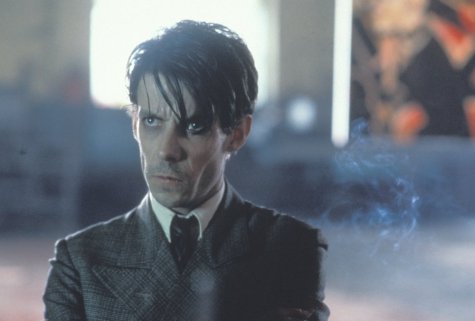
Max is a “What if?” story. Though they never meet, the two angels of Hitler’s nature compete for his soul, and as no viewer of the film can miss, for the soul of the entire world. Rothman, a champion of the new Expressionism, tells him, “You’ve got to take all this pent-up stuff that you’re quivering with and hurl it onto the canvas…Get out of politics…If you put the same amount of energy into your art as you do into your speeches, you might have something going.” But Hitler’s attempt to tap into his pain and rage goes nowhere artistically. Are his wounds too strong, his discipline too weak, or his talent simply absent? Perhaps all three.

But there is an easier way out (one that Black Swan’s Nina does not take) – the lure of scapegoating others as a way to deny his pain. Mayr’s advice is superficially similar but more convincing: “You’ve got your own talent.” – which clearly has nothing to do with painting – “Just let it out!”

The difference between this fictional Hitler and fictional Nina is critical and instructive. Because she is both deeply talented and highly disciplined, she is able (at least for a while) to hold the almost unbearable tension between her angel and her demon. Some might say that because she symbolically kills the demon, she can’t hold that tension for long. But she does make great art – if only for a moment – and contributes a lasting gift to the dance world. Adolf, on the other hand, is at best a second-rate artist, and he simply cannot improve his technique or – more importantly – work the terrible nature of his soul.

But he does “go deeper,” and he begins to muster a particular discipline that will focus on the development of a charismatic personality (from persona, mask). Apparently having made his choice between art as art and art as propaganda, he tells Max,

Go deeper, you said. I went deep. Deeper than any artist has gone before! This is the new art! Politics is the new art!…Art and politics equals power!

Late in the film, Max realizes that Hitler’s art is “futuristic kitsch.” Nevertheless, he attempts to channel that ferocity into the art world, where it might be less harmful to society: “You finally found your voice – the future as a return to the past.” But Hitler, as we know, will succumb to the lure of that mythical past and potentially future greatness. The film ends on Christmas eve, 1918, as Max is murdered by thugs whom Hitler had provoked.

Though not portrayed in Max, less than two weeks later, leftists would go on general strike in the violent Spartacist uprising. Hitler’s fascist allies will prevail, and Germany will begin its spin into that future.

Here is both the contrast with the ballerina and the frightening commentary on our current culture and politics. Nina will crack the masks of Black and White in dramatic expression, while Hitler will retreat behind a different mask and inhabit it for an entire nation. With neither her talent, nor her commitment, nor an artistic community like hers – an authentic ritual container – he falls victim to his own darkness and the peculiar darkness of his culture (think Darth Vader here – “Vader” is German/Dutch for “father”). He succumbs to the easy lure of projection – hatred of the Other – and discovers – we discover – how hate can make its own community.

In doing so, Hitler becomes a conduit for the darkest forces of the psyche and the world. As we know, he will briefly succeed in restoring a sense of destiny – and wounded innocence – in an entire nation. Max was filmed in 2001, the same year as the beginning of the “War on Terror.” I doubt if its creators had the theme of American innocence in mind, but nearly twenty years later, we would be fools, wallowing in our own denial, not to see the parallels.

Read Part Seven here

Categories
Uncategorized

Barry’s Blog # 331: Black Swans and White Vultures, Part Five of Seven

To become an American is essentially to divest oneself of a past identity, to make a radical break with the past. – Herman Melville

…the world’s fairest hope linked with man’s foulest crime. – Herman Melville

What is this standard of “whiteness” by which Europeans and Americans have defined themselves for so long? My book argues that American whiteness is actually a perceived “not-redness” and “not-blackness.” In other words, countless White people believe that they know who they are because they lack the characteristics of the Other: primitive, lazy, irrational, impulsive, violent, untrustworthy or promiscuous.

And let’s be crystal clear about this. These are all psychological projections through which White Europeans have perceived people of color throughout the Third World in order to justify the terrible crimes of colonialism and convince themselves of their own innocence. And for a thousand years they have sent their young men to rape, slaughter and die for God’s will to triumph, often perpetrating the most hideous atrocities upon the truly innocent “for their own good.”

Taking this moral disorder to its pathological extreme, Captain Ahab believes that the white whale that men call Moby Dick is the embodiment of pure evil. And let’s be clear about this as well: why does Ahab hate the whale with such malicious intensity? Because on a previous voyage, the whale had taken his leg in self-defense while Ahab was hunting him. In his personal (and national) madness, Ahab, lifelong butcher of whales, has convinced himself that Moby Dick had victimized him, and has taken on the role of the Old Testament god of vengeance. b7f10a1c1d0c4bd80cc2af2f82d41647

But why a white whale?

Chapter 42 (The Whiteness of The Whale) has been described as “…the heart of the entire work.” Melville begins it with the common ideas of whiteness symbolizing beauty, innocence and goodness. But then he addresses the mystery of identity that propels our hateful obsessions about the Other:

…there yet lurks an elusive something in the innermost idea of this hue, which strikes more of panic to the soul than that redness which affrights in blood…which causes the thought of whiteness, when divorced from more kindly associations, and coupled with any object terrible in itself, to heighten that terror to the furthest bounds. Witness the white bear of the poles …that the irresponsible ferociousness of the creature stands invested in the fleece of celestial innocence and love; and hence, by bringing together two such opposite emotions in our minds, the Polar bear frightens us with so unnatural a contrast.

…even the king of terrors, when personified by the evangelist, rides on his pallid horse…it is at once the most meaning symbol of spiritual things, nay, the very veil of the Christian’s Deity; and yet…the intensifying agent in things the most appalling to mankind…Is it that by its indefiniteness it shadows forth the heartless voids and immensities of the universe, and thus stabs us from behind with the thought of annihilation?…is it for these reasons that there is such a dumb blankness, full of meaning, in a wide landscape of snows – colorless, all-color of atheism from which we shrink?…pondering all this, the palsied universe lies before us a leper…And of all these things the Albino whale was the symbol. Wonder ye then at the fiery hunt?

Perhaps Melville was also acknowledging the chasm of meaningless that lies just below the surface of American identity and its assumptions about race and innocence. Interested readers should read Richard Slotkin’s great Regeneration Through Violence trilogy.

Gabrielle Bellot writes that just below the narrative of Moby Dick is the theme of race:

…it is a template for Melville’s, and our, America: a world populated as much with gestures towards racial equality as with casual racist assumptions…chasing Moby Dick, that avatar of whiteness, means fighting against the meaninglessness of the world, hoping that, through some bloody violence, life-purpose will bloom into existence. Ahab pursues the whale out of a manufactured anger, in a quest to give his life some vague value…

Six years after the publication of Moby Dick and three years before the Civil War, Melville completed his thinking about the white / red / black triad of American innocence, writing (in The Confidence-Man) of “Indian hating.” It was a unique dimension in which religious zeal, barbaric cruelty, capitalist land-grabbing and sacrificial ritual merged to create genocide. What Ahab had attempted to do to the white whale, his nation had been doing to its original inhabitants for 250 years. It was so ingrained in the national character that by Melville’s time, hatred of Indians had become a “metaphysic.”

Nearly a hundred and seventy years after Moby Dick, millions – perhaps tens of millions – of Americans continue to wrestle, knowingly or not, with the question of identity. Who the Hell are we? Are we nothing more than “not the Other”? Does our “manufactured anger” – or more accurately, displaced anger – give our lives “some vague value”? Is there still a positive definition of “American” that we can speak out loud without laughing or weeping? The good news is that countless good-hearted liberals have been offered the opportunity to awaken from their life-long trance of innocence and privilege. The bad news…well, you know the bad news. For more on the issue of white privilege, see my essays “Privilege” and “Affirmative Action For Whites.”

…this is the crime of which I accuse my country and my countrymen and for which neither I nor time nor history will ever forgive them, that they have destroyed and are destroying hundreds of thousands of lives and do not know it and do not want to know it…but it is not permissible that the authors of devastation should also be innocent. It is the innocence which constitutes the crime. – James Baldwin

Read Part Six here.

Categories
Uncategorized

Barry’s Blog # 330: Black Swans and White Vultures, Part Four of Seven

Every act of creation is first an act of destruction. – Pablo Picasso

Whatever white people do not know about Negroes reveals precisely and inexorably what they do not know about themselves. – James Baldwin

As long as we are at home in the body, we are absent from the Lord. – Increase Mather

Cut loose from the earth’s soul, they insisted on purchase of its soil, and like all orphans they were insatiable. It was their destiny to chew up the world and spit out a horribleness that would destroy all primary peoples. – Toni Morrison, A Mercy

I’d like to imagine that the Australian stories of black swans who became men refer to times (as in Greek myth) when gods and mortals walked the Earth together in harmony, when soul and spirit, body and mind, male and female or nature and culture were not so terribly divided as they are in our post-modern language, religion, environment and politics.

For hundreds of years, these polarities have been most concretely symbolized by black and white, leading to definitions of “black” that include:

– Causing or marked by an atmosphere lacking in cheer

– Not conforming to a high moral standard;

– Being without light

– Unclean

Black: the Black Death, black shirts, black cats, black crows, Black Panthers, black leather, black holes, black magic, the black knight, the black inquisitor, the black-clothed Puritan, the chimney sweep, the witch, the magician, the Grim Reaper, the Heart of Darkness, and of course, Black people. Our mythologies and theologies create values that praise a “white” world. Hillman writes:

…the negative and privative definition of black promotes the moralization of the black-white pair. Black then is defined as non-white, and is deprived of all the virtues attributed to white. The contrast becomes opposition, even contradiction…(and) gives rise to our current Western mind-set, beginning in the 16th and 17th centuries, the Age of Light, where God is identified with whiteness and purity, and black…becoming ever more strongly the color of evil.

Indeed, well before the age of colonialism, it was obvious to Europeans that blackness lacked the virtues associated with whiteness. In 1488 it was nothing unusual for Pope Innocent (!) VIII to give African slaves as presents to his cardinals.

But depth psychology – and Black Swan – insist that the more we identify with white, the more seductive black becomes. Above all, however, black is terrifying because it threatens (or invites) the collapse of the whole house of cards. I quoted Hillman above:

Therefore, each moment of blackening is a harbinger of alteration, of invisible discovery, and of dissolution and of attachments to whatever has been taken as dogmatic truth and reality, solid fact, or dogmatic virtue. It darkens and sophisticates the eye so it can see through.

We are all well aware in our bones, in our indigenous roots, that the white imagination, white thinking and even white privilege are profoundly unsatisfying. At that level we all know that our fear and hatred of both the internal, Black Other and the external, Red Other (originally the Red Indian, and for most of the 20th century, the Red Communist) merely cover over our envy and our desire to make peace with them and ourselves. However, we are also well aware that our demythologized world no longer provides secure ritual containers for the painful work of remembering who we really are. D. H. Lawrence knew this a hundred years ago:

I am not a mechanism, an assembly of various sections.
and it is not because the mechanism is working wrongly, that I am ill.
I am ill because of wounds to the soul, to the deep emotional self,
and the wounds to the soul take a long, long time, only time can help
and patience, and a certain difficult repentance
long difficult repentance, realization of life’s mistake, and the freeing oneself
from the endless repetition of the mistake
which mankind at large has chosen to sanctify.

So, while black (as descent into darkness and as African-American culture) invites America to heal the world and heal itself, most of us still take the easier way out, into hatred and scapegoating.

Black Swan, for all its references to a classical art form, is an American film. It takes place entirely in America’s cultural center. We view it, regardless of our superficial idealisms and ideologies, as Americans. And not just as Americans, but as Christians. Hillman writes:

You may be Jew or Muslim, pay tribute to your god in Santeria fashion, join with other Wiccas, but wherever you are in the Western world you are psychologically Christian, indelibly marked with the sign of the cross in your mind and in the corpuscles of your habits. Christianism is all about us, in the words we speak, the curses we utter, the repressions we fortify, the numbing we seek, and the residues of religious murders in our history…Once you feel your own personal soul to be distinct from the world out there, and that consciousness and conscience are lodged in that soul (and not in the world out there) and that even the impersonal selfish gene is individualized in your person, you are, psychologically, Christian.

Elsewhere, he places mental illness within this context:

As long as we are caught in cycles of hoping against despair, each productive of the other, as long as our actions in regard to depression are resurrective, implying that being down and staying down is sin, we remain Christian in psychology…Yet through depression we enter depths and in depths find soul. Depression is essential to the tragic sense of life…It reminds of death. The true revolution begins in the individual who can be true to his or her depression.

So we speak of Black Swan in American language, where the fundamental symbolism of white and black has never relaxed its hold on our imaginations. Also a hundred years ago, Carl Jung wrote,

When the American opens a…door in his psychology, there is a dangerous open gap, dropping hundreds of feet…he will then be faced with an Indian or Negro shadow.

Linguistic research indicates that some languages have only one color distinction: black and white. In languages with a third color term, that term is invariably red. How ironic that over time, in a curious blend of history and archetype, the American soul projected itself in red, white and black images, as I describe in Chapter Seven of my book. White, of course, speaks to us of our national sense of innocence, while in our language and mythology, black and red came to represent the “Others” who threaten us from within and from without.

As early as the late seventeenth century, America’s primary model for class distinction (and class conflict) had become relations between white planters and black slaves, rather than between rich and poor. The new system, writes Theodore Allen (author of The Invention of the White Race), insisted on “the social distinction between the poorest member of the oppressor group and any member, however propertied, of the oppressed group.”

Consider that statement again. This our American heritage. In most parts of the country, for most of American history, despite the ideology of freedom and equality, absolutely everyone understood that white skin color conveyed infinite privileges over anyone with black skin, regardless of one’s economic status. And the brutal polarity of identity received religious confirmation. Since poverty equaled sinfulness (to the northern Puritan) and black equaled poor (to the southern Opportunist), then it became obvious that blackness equaled sin.

The process of exclusion and subordination required a massive lie about black inferiority that has been enshrined in our national narrative. “After all,” writes activist Tim Wise, “to accept that all men and women were truly equal, while still mightily oppressing large segments of that same national population on the basis of skin color, would be to lay bare the falsity of the American creed.” Similarly, the French philosopher Montesquieu wrote, “It is impossible for us to suppose these creatures to be men, because, allowing them to be men, a suspicion would follow that we ourselves are not Christian.”

The myth of the Old South, writes Orlando Patterson, stated that the presence of the Other, not a slavery-based economy, had caused its shameful defeat in the Civil War (or, the “War of Northern Aggression”). The ex-slave symbolized both violence and sin to an obsessed society. He was “obviously” enslaved to the flesh, and his skin invited a fusion of racial and religious symbolism. His “black” malignancy was to the body politic what Satan was to the soul. “The central ritual of this version of the Southern civil religion…was the human sacrifice of the lynch mob.

In 1899, before torturing him, ten thousand Texans paraded their black victim on a carnival float,450834550_640like the King of Fools, like Dionysus in the Anthesteria, or like Christ at Calvary. Patterson writes, “…the burning cross distilled it all: sacrificed Negro joined by the torch with sacrificed Christ, burnt together and discarded…”

But in 2020 we continue to make a terrible mistake when we locate racism exclusively in the South, or exclusively among reactionaries, blatant racists or the uneducated. Prior to the Civil War, Northern mobs attacked abolitionists on over two hundred occasions.

Joel Kovel asserts that there are two kinds of racism. One is the obvious dominative racism that developed in close contact (including the privilege of rape) between master and slave. The second – aversive racism – arose from Puritan associations of blackness with filth. De Tocquevile wrote in Democracy in America that prejudice “appears to be stronger in the states that have abolished slavery than in those where it still exists; and nowhere is it so intolerant as in those states where servitude has never been known.”

Indeed, New England had about 13,000 slaves in 1750.  In 1720, New York City’s population of seven thousand included 1,600 blacks, most of them slaves. And the two colonies with the strongest religious foundations – Massachusetts and Pennsylvania – were the ones that first outlawed “miscegenation.”

The terrible logic of “othering” – its logical conclusion – takes hatred beyond the requirements of capitalism, beyond the entertainment uses of race, all the way to genocide. Again, as recently as hundred years ago, twenty-seven states passed eugenics laws to sterilize “undesirables.” A 1911 Carnegie Foundation “Report on the Best Practical Means for Cutting Off the Defective Germ-Plasm in the Human Population” recommended euthanasia of the mentally retarded through the use of gas chambers.

Gas chambers.

The solution was too controversial, but in 1927 the Supreme Court, in a ruling written by Oliver Wendell Holmes, allowed coercive sterilization, ultimately of 60,000 Americans.

The last of these laws were not struck down until the 1970s. But now, with the coronavirus pandemic throwing millions out of work and onto the streets, the most extreme forms of gratuitous cruelty are re-emerging, with several prominent Republicans hinting that it would be better to let thousands of elderly – and Black and Brown – people die rather than keep the economy (and Trumpus’ re-election chances) in prolonged jeopardy. I’ll speak more about euthanasia below.

For some three hundred years, the distinction between black and white, with all of its moral implications, has remained absolutely central to white, Christian identity. And especially in times of economic uncertainty, any factual or emotional arguments to the contrary – or gestures of black equality – continue to provoke immense anxiety in the white mind and justify the most reactionary politics. In 2020, ten years after Black Swan was released, whites in Georgia lynched a black man for the crime of jogging through their neighborhood.

Read Part Five here.

Categories
Uncategorized

Barry’s Blog # 329: Black Swans and White Vultures, Part Three of Seven

Whoever isn’t busy being born is busy dying. – Bob Dylan

In mythology, swans (which we naturally assume to be white) are linked to Aphrodite, Artemis, Apollo, Brigid and the Virgin Mary. Solar gods such as Zeus and Brahma, White Buffalo Calf woman and the Celtic deities Belanus and Lugh descend from Heaven disguised as swans. Saraswati rides a swan. Various sources claim that swans symbolize purity, grace, beauty, loyalty (they mate for life), unity, love, hope and transformation (they migrate, and the Ugly Duckling transforms into one). As such, they are popular images on jewelry, T-shirts, tattoos, coffee mugs and every kind of souvenir. Above all, the white swan embodies the attributes of spirit.

In Chapter Two of my book I discuss the differences between spirit and soul:

Concepts, like Apollo, are detached; they neutralize our direct participation in the world, distancing us by relying on the eye’s passivity, assessing from safe distances. Percepts are involved, relying on the “secondary” senses (olfactory, tactile, acoustic.) We are “perceptive” when we penetrate to the core. However, each requires the other – what we might also call soul and spirit – for completion, since life will not be confined to a single mode of knowing. Spirit is transcendent and soul is immanent. Zen teacher John Tarrant writes:

“…where spirit is too dominant, we are greedy for pure things: clarity, certainty, and serenity… (but) soul in itself does not have enough of a center…If soul gives taste, touch, and habitation to the spirit, spirit’s contribution is to make soul lighter, able to escape its swampy authenticity, to enjoy the world without being gravely wounded by it.”

Historians portray Greek civilization as extremely rational. But the Greeks themselves imagined a balance between the brothers, which they enshrined at Delphi, their religious center. Apollo relinquished it to Dionysus for three months each year.

The history of religion is an unstable relationship between these opposites, with rebellious impulses periodically threatening patriarchal control. Perhaps all history oscillates between Apollonian order and Dionysian energy. Cultural stability, however, requires a dynamic, ever-shifting balance. Too much sunshine dries us up, while excess moisture rots us and drives us crazy. Extreme order leads to stagnation, dogma and authoritarianism; too much reliance on the intuitive soul brings chaos, anarchy and collapse. Emphasizing one extreme, we eventually endure the other as a correction. When society literalizes Apollo’s spiritual beauty into formal religion, correct behavior and rational science, then literalized – and potentially violent – Dionysian subcultures arise.

The black swan is a highly evocative image in its own right and often seems to invite the internal movement into the dark spaces of soul.

Well before this film appeared in 2010, we find many references in popular culture. The Black Swan was a 1942 Tyrone Power swashbuckler pirate film based on a 1932 novel of the same name by Rafael Sabatini. At least eleven other writers (including Thomas Mann) have published short stories or novels with Black Swan as title. There are at least three independent Black Swan bookstores, in California, Kentucky and Virginia. There’s a Black Swan brand of barbeque sauce, and a Black Swan home décor store in Connecticut. Black Swan Green is the name of an English village in the novel of the same name by David Mitchell. Singers and rock bands have recorded at least twelve separate songs, albums – and an opera – with Black Swan in the titles.

Black Swan Theory is a metaphor used by economists and financiers. Black swan events are characterized by their extreme rarity, their severe impact, and the widespread insistence they were obvious in hindsight. The term is based on an ancient assumption that actual black swans did not exist – until they were discovered in the wild.

The phrase “black swan” itself derives from the 2nd-century Roman poet Juvenal‘s characterization of something being “rara avis in terris nigroque simillima cygno” (“a rare bird in the lands and very much like a black swan”). Philosophers such as John Stuart Mill, Bertrand Russell and Karl Popper have used the metaphor to describe the fragility of any system of thought. A set of conclusions is potentially undone once any of its fundamental postulates is disproved.

But by far the most common use of the term is in Australia, where “swan” almost always implies black swan. It is Australia’s Coat_of_arms_of_Western_Australia.svgonly native swan and is an official symbol for the state of Western Australia, as depicted on its flag and coat-of-arms. The symbol appears on Australian coins, postage stamps, Australianstamp_1623logos, mascots, sports teams, businesses, corporations, railways, universities, hospitals, mines, religious heraldic emblems, a literary magazine and several dozen place names including streets, towns, districts, rivers and islands.600px-Flag_of_Western_Australia.svg


So much for the swan as symbol of national pride, or as gang color, if you prefer. But more to our purposes, it seems that “black swan” may also indicate a grudging acceptance of the nation’s own dark side, its indigenous, Aboriginal people who long before had named most of those places with terms that translate as black swan. Indeed, in the 1920s anthropologists recorded a man known as the “last of the black swan group” of the Nyungar people, who claimed that their ancestors were once black swans who became men.

Read Part Four here.

Design a site like this with WordPress.com
Get started