Categories
Uncategorized

Barry’s Blog # 137: Did the South Win the Civil War? Part Two of Nine

Part Two – The Lost Cause

Men are not flattered by being shown that there has been a difference of purpose between the Almighty and them. – Abraham Lincoln

In 1877, the Reconstruction period ended with a compromise that removed federal troops from the last three occupied Southern states, enabling Democrats to gain complete political control of the South. Northerners, sick of the expensive effort to enforce equality in the South, were only too willing to drop the issue entirely. In exchange, the Republican Rutherford B. Hayes became President.

Soon, whites everywhere colluded in the “Lost Cause” myth. Immediately after the war, in 1866, Edward A. Pollard’s book The Lost Cause: A New Southern History of the Confederates  portrayed the Old South as a multicultural paradise of racial harmony untouched by the evils of industrial capitalism. It sought to recast the struggle to perpetuate slavery as a noble defense of a traditional way of life, led by gallant gentleman-officers and fought by loyal soldiers in the “War of Northern Aggression”. It even invented stories of Blacks who fought alongside them.

Conspiracy theories: in another parallel to current events, writes Tyler Parry, “nostalgic whites and their descendants believed such stories were being intentionally suppressed” by the Eastern press and liberal academics.

The United Daughters of the Confederacy (founded in 1894), along with the Sons of Confederate Veterans (1896), played a central role in the public vindication of their parent’s wartime experiences. Historian Karen Cox insists that it was mostly women, not men, who shaped the South’s (and the nation’s) memory of the war. They erected 700 monuments and built retirement homes for old soldiers and widows. But their most effective tool was the pro-Southern literature they forced into the region’s schools to educate the young about the just cause of states’ rights.

Textbooks, like the 1908 History of Virginia by Mary Tucker Magill, white-washed slavery: “Generally speaking, the negroes proved a harmless and affectionate race, easily governed, and happy in their condition.” This idea prevailed half a century later in the textbook Virginia: History, Government, Geography, used in seventh-grade classrooms into the 1970s:

Life among the Negroes of Virginia in slavery times was generally happy. The Negroes went about in a cheerful manner making a living for themselves and for those for whom they worked.

A high school text went into more fanciful detail about the slave:

He enjoyed long holidays, especially at Christmas. He did not work as hard as the average free laborer since he did not have to worry about losing his job. In fact, the slave enjoyed what we might call collective security. Generally speaking, his food was plentiful, his clothing adequate, his cabin warm, his health protected, his leisure carefree. He did not have to worry about hard times, unemployment, or old age.

These texts were ubiquitous. Greg Huffman estimates that seventy million students were enrolled in the South’s public elementary and secondary schools between 1889, when the government began counting students, and 1969, the height of the segregationist Jim Crow era. All of them were subjected to this false version of U.S. history, since the UDC’s primary focus was on insuring that Southern schools used only those history books that defended slaverypraised the Ku Klux Klan and banned those books that didn’t. And they exerted great influence on Northern book publishers as well, who

…had decisions to make if they wanted to sell books to Southern schools. Go all in with Lost Cause dogma and be able to sell the book only in the South? Or have two versions of the same book — one with carefully worded, watered-down history for the South, and another one with historical facts for everyone else? The latter was often the choice. This also meant that books covering only state history tended to have a local author, a local publisher — and a stronger Lost Cause bias.

Bad history persists, writes Steve Hochstadt, because those in power can enforce it by harassing its critics. In the 1950s,

It was easy for the FBI and conservative organizations to pinpoint those academics, journalists, and film directors who dissented from the Lost Cause ideology. They could then be attacked for their associations with organizations that could be linked to other organizations that could be linked to Communists. These crimes of identification were made easier to concoct because of the leading role played by American leftists in the fight against racism during the long 20th century of Jim Crow.

Mississippi’s public schools used Lost Cause textbooks exclusively until a federal court order forced them stop in 1980. But the textbook situation persists even in the 21st century.

Now, with millions of Republicans consuming the most absurd visions of who they are and what they think they know, the great-great-granddaughters of the Confederacy are having their way. Two weeks before Juneteenth, the Georgia Board of Education (by an 11-2 vote) joined the Red State stampede to rewrite history and keep their public school students (3 out of 5 of whom are children of color) from learning that racism is a real, current problem created by longstanding structural inequality. This move reflected the pernicious influence of right-wing media such as Fox News, which mentioned “critical race theory” 1,300 times over the past three-and-a-half months.

Why are the Daughters of the Confederacy important now? Because they became the spiritual ancestors of all the right-wing women of the past forty years, from Phyliss Schlafly to Sarah Palin to Michele Bachman to Ann Coulter to Laura Ingraham to Kellyanne Conway to Nikki Haley to Marjory Taylor Greene to the majority of white women who voted twice for a vile misogynist and accused rapist whose policies hurt their own children. Even more than the angry, working-class men we all heard about, white women voted against so many of their interests in favor of fear, privilege and hate. For them, it seems that the South should have won the war. 

The end of Reconstruction and falsification of history are mythological issues. Generations of Northern and Southern whites consumed a new creation story that to a great extent replaced those of the Pilgrims and the Founding Fathers: the nation had survived its greatest crisis and experienced a rebirth and unification that would express itself in both further imperial expansion, further inequality and further historical amnesia.

It is no coincidence that nationalism arose in exactly those years that saw massive immigration, unionization, labor strife and huge concentrations of wealth in what came to be known as the Gilded Age.

The myth of a reunited America with a national purpose, along with hugely popular Horatio Alger tales of enterprising young men who prospered on their own merit, was just what the oligarchs of both North and South needed to distract the working classes from uniting. Within two generations, most white Americans remembered the war as one “between brothers.”

1e7067b9c7d6975b43ecc9f72879e540

The issues that had caused the war faded away (except of course in the minds of Black, Brown, Yellow and Red people), but the long-term psychological wounds in the national character that led white men to erupt in regular expressions of genocidal violence did not. By the turn of the century, American troops (primarily Southerners) in the Philippines were massacring tens of thousands of indigenous people, whom they referred to as “niggers”, precisely when lynching was at its height at home. Later, they would take no Japanese prisoners, refer to Viet Nam as “Indian country” and denigrate Iraqis and Afghanis as “sand niggers” as they carried their Confederate flags into battle.

Actually, the process of fading and forgetting began well before the end of Reconstruction. Lincoln’s successor Andrew Johnson granted full amnesty to Confederate soldiers in 1868. Prior to that, he had already overturned General Sherman’s offer of “forty acres and a mule”  and other programs for the recently emancipated Blacks. Christopher Petrella writes:

Such a juxtaposition is emblematic of the logic of the U.S. racial state: provide civic inclusion for treasonous white confederates and continue a policy of civic exclusion for newly liberated Black children, women, and men. Johnson’s strategic re-birth of the nation – “a country for white men [and] a government for white men,” in his words – helped to alleviate the crisis of whiteness generated by the Civil War and recenter its homogenizing supremacy.
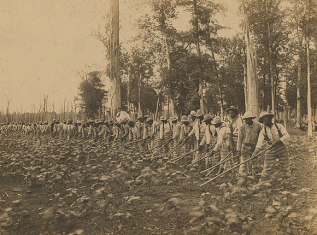
Parchman_prison_convict_labor_1911

There was a mild degree of land distribution, and by 1910 a quarter of Southern Black farmers (compared to 63% of white farmers) owned 15,000,000 acres, a number that would decrease to 2,000,000 acres by 1997, largely because of long-term racist policies in the U.S. Department of Agriculture. But most poor Southerners, Black or White, had few alternatives to working as sharecroppers on the large plantations.

In 1872 Congress passed an amnesty act that returned the right to hold office, as well as their property, to all but five hundred men of the Confederate leadership. A century later, the government restored full citizenship to Robert E. Lee and Jefferson Davis. In 1978, President Jimmy Carter proclaimed, “…Congress officially completes the long process of reconciliation that has reunited our people…” This occurred thirty years before it officially apologized to Black people for slavery. Petrella concludes that “the idea of amnesty itself is only legible through a priori claims to civic belonging, a concept itself that is racialized as white.”

Because the nation failed to punish the leaders of the Confederacy, landholding and wealth-holding in the South never changed. Some of these rural areas are still run by the descendants of the people who ran the big plantations.

This new story – this new foundational myth – was based on the acceptance of the South’s number two objective. For generations, the vast majority of whites, North and South, agreed that blacks, though they had been granted legal equality, were not sufficiently evolved to vote, to exercise political authority, or to have their children schooled along with white children.

And this agreement in turn was based upon the fear of miscegenation, or race-mixing. Racism remained the foundation of a political economy predicated upon fear, the constant threat of violence, division of the working class and further refinements of whiteness and white privilege. The white national psyche was so obsessed with racial purity that laws long defined blacks as persons with any African ancestry. The “one-drop rule,” used by no other nation, made one a black person. “Octoroons,” who had seven white great-grandparents out of eight, were considered to be black. German Nazis copied American attitudes, especially in terms of Eugenics. But even for some of them, writes James Q. Whitman, “American race law looked too racist”.

You can read Part Three of this essay here.

Categories
Uncategorized

Barry’s Blog # 136: Did the South Win the Civil War? Part One of Nine

Part One – Privilege and Insecurity

 …one of the reasons people cling to their hates so stubbornly is because they sense, once hate is gone, they will be forced to deal with pain. – James Baldwin

 Juneteenth is a new national holiday! On June 19th, 1865, Union soldiers arrived in Texas with news that the Civil War was over and that the enslaved were free. This was over two months after the Confederate surrender and two and a half years after the Emancipation Proclamation. Why did they take so long? Some tell stories of messengers who were murdered. Others say that plantation owners withheld the news to maintain the labor force as long as possible, or that federal troops actually waited for them to reap the benefits of one last cotton harvest.

This pattern of dis-information became a model for the years to come, all the way up to the fake news and alternative facts of our current times, and it meshed with a national character that has always welcomed it. In their guts, White people have always known the truth. But the mythology (or if you prefer, the propaganda) of innocence has generally overcome the wisdom of the body, because part of this mythology has always been about hatred of the body. So I’d like to ask: Did the South actually win the Civil War?

Of course, the Confederacy lost the actual war. Legalized slavery ended and the Union was saved. Of course, black people have equal rights and are better off economically. Why, we even had a black president.

Now let’s talk about reality. To do so, let’s consider the South’s objectives at the start of the Civil War:

1 – Preservation of slavery

2 – Expansion of white supremacy throughout the whole nation

3 – Division of the working class by motivating white people through fear

4 – Expansion of American imperialism across the world

5 – Erosion of federal authority and acceptance of “state’s rights”

6 – Free trade, or low tariffs on foreign manufactured goods

All African Americans know that their rights and freedoms have been gained and then reversed before, and that this can happen again.

Clearly, the Southern oligarchs were determined to preserve and expand slavery. It was enshrined into the very first article of the Confederate Constitution, and all the insurrectionary states listed it as their first reason for rebelling. For its impact on our 21st century, however, we really need to understand what motivated poor whites, perhaps a third of the South’s population. Keri Leigh Merritt writes,

…they were surplus workers competing in a labor market with brutalized, unpaid enslaved people. After the forced migration of around eight hundred thousand enslaved laborers from the Upper South to the Deep South in the 1830s and 1840s, job opportunities for poor whites were scarce.

These were men who couldn’t imagine having the resources to actually own slaves. So why did several hundred thousand of them fight for the Confederacy? Certainly, most of them were draftees, and many deserted. But of those who remained, why did they defend this cause so savagely? We are in the realm of a profound mystery, and we cannot understand the mess the nation is in now without confronting it.

The answer is clear, even if it opens us to further mystery. By 1700, allegiance to the idea of whiteness had eliminated class competition and created a population of poor whites to intimidate slaves and suppress rebellion. Very soon, America’s primary model for class distinction became relations between free whites and enslaved blacks, rather than between rich and poor. The new system, writes Theodore Allen, insisted on “the social distinction between the poorest member of the oppressor group and any member, however propertied, of the oppressed group.”

Long after the first slave patrols were formed and poor Southern whites received their indoctrination into the realities of caste, they fought not to save slavery (which was against their own economic interests), but to perpetuate white privilege.

Without these non-economic privileges and the projection of all evil onto Blacks, the concepts of whiteness – and to a very great extent, American masculinity – were and are meaningless. A century and a half after the end of the war, this legacy means that large numbers of relatively affluent people (most Tea Partiers and Trumpus supporters are not working class) actually believe that they have been persecuted by people who have far less money and far less influence than they do. No matter how impoverished a white, male American feels, he still receives subtle messages every day that divide him from those our mythology designates as impure. For generations, many such men have had nothing to call their own except this privilege, yet they cling to it and support those who promise to maintain it.

The plantation owners were quite clear about this. In 1860, one of them wrote about the consequences of Lincoln becoming President:

The color of the white man is now, in the South, a title of nobility in his relations as to the negro…where menial and degrading offices are turned over to be performed exclusively by the Negro slave, the status and color of the black race becomes the badge of inferiority, and the poorest non-slaveholder may rejoice with the richest of his brethren of the white race, in the distinction of his color. He may be poor, it is true; but there is no point upon which he is so justly proud and sensitive as his privilege of caste; and there is nothing which he would resent with more fierce indignation than the attempt of the Abolitionist to emancipate the slaves and elevate the Negroes to an equality with himself and his family.

This shouldn’t obscure three facts. Northerners were also deeply racist; slavery supported many of their largest businesses; and it was deeply integrated with the global economy. But it ought to help us understand why the deep insecurity of Southern whites (and those in the western states they later populated) would be so easily manipulated by cynical politicians throughout the decades that followed the war. It should help us understand why whites from all sections of the country agreed to prematurely end Reconstruction in favor of a new myth of a reunited America, and why they tolerated or ignored racial discrimination for so long.

The South’s objective of preserving slavery failed, but only in a strictly legal sense. For decades, millions of African Americans remained on the land as virtual slaves working as sharecroppers, unable to better their conditions and terrorized by the constant threat of violence.

Well before the advent of Trumpus, these same forces have been reasserting the old conditions. As I have written, the myth of American Innocence is rapidly collapsing, and the search for scapegoats has intensified. Those conditions didn’t disappear in 1865. The mythological sources of white rage persist. In 2021, white males are more scared about the loss of their privileges, more anxious about their own masculinity, more willing to blame others and angrier than ever.

Academics have traditionally portrayed the South as an exception to the grand story of liberal American progress. Others argue that racial strife, police brutality, mass shootings, urban massacres, economic backwardness, mass incarceration, reactionary politics, fundamentalist religion, environmental degradation, support for the military, fascination with firearms and a deep suspicion of outsiders are hardly unique to the region.

In practical terms, were these always American characteristics from the very beginning, as my book argues, or did Southern values eventually come to predominate in large swarths of the country? Could Trumpus – or either of the Bushes, or Reagan – have won the Presidency without manipulating white America’s fear of dark-skinned people, even though most of their other policies have been deeply unpopular?

You can read Part Two of this essay here soon.

Categories
Uncategorized

Barry’s Blog # 368: Deconstructing a Gatekeeper, Part Three of Three

If the Nuremberg laws were applied, then every post-war American president would have been hanged. – Noam Chomsky

That’s a provocative quote, and it has serious implications. Is Chomsky being literal? If we take it at face value – culpability in the bombing of over forty sovereign nations since the end of World War Two, murder and torture of literally millions of civilians and indigenous people, CIA drug running and assassinations, environmental destruction and global warming – then anyone in government, military or corporate capitalism who knowingly took part in such activities shares the responsibility. And the storytellers, anyone of influence in education, religion, the history profession and especially “journalism” – who abetted such activities by subtly justifying them is also responsible.

Knowing that I write about how fear of the Other is a major theme in American myth and politics, a friend recommends another of Brooks’ NYT articles: “On Conquering Fear”. It references the Passover prayer book (the Haggadah) and offers “subtler strategies and techniques to conquer fear.”

Brooks tells us that in the Moses story, Hebrew married couples were immobilized by fear of Egypt’s Pharaoh. But by “challeng(ing) each other to see beauty in the other,” they “began to sense unexpected possibilities.” Once people started speaking to each other and telling stories to each other, they generated alternate worlds. Storytelling became central to conquering fear. A story isn’t an argument or a collection of data, he says. It contains multiple meanings that can be discussed, questioned and reinterpreted (and that’s exactly how we need to respond to Brooks).

Later, at the critical point when the Israelites face the crossing of the Dead Sea, they begin to sing – not in celebration, but to overcome their fear. Their “climactic break from bondage is thus done in a mood of enchantment.” So “the sophisticated psychology of Exodus” teaches that it is sometimes wise to confront fear “obliquely and happily, through sexiness, storytelling and song.”

I sincerely praise Brooks for a fine article. In this age of heightened – and manipulated – fear, we could all appreciate this message. Perhaps the only way to transcend the paranoid imagination is by turning toward the creative imagination through art and ritual.

But we can’t consider what this article says without acknowledging what it doesn’t say. This is my responsibility as a mythologist to you as the reader. Then it becomes your responsibility to think mythologically, to train yourself to identify the subtle ways in which media gatekeepers continuously manipulate our dominant narratives to revive the myth of innocence. So let me unpack it, if you don’t mind.

First of all, consider the massive irony that an article about facing fear was penned by a persuassive media giant who has supported all of the American empire’s military adventures with all the usual fearmongering and has written countless other articles that have helped to ratchet up the level of fear in the culture. The media watchers FAIR (Fairness and Accuracy in Reporting) include Brooks in their list of “Highly Placed Media Racists.” Why? Because his “reasoned, moderate” essays often reference outright, unreconstructed bigots.

If his article has any wisdom to offer, remember the old joke that even a broken clock is right twice a day. Now let’s look at the text of the article, which constantly refers to the myth (remember that there is no actual archeological record for it) of the Exodus. I offer two points to consider:

One: the people in his story who experience fear are the Israelites, not the Egyptians. Stories of Jewish fear are familiar to us, quite justified from Roman to medieval persecutions to the Holocaust, all the way to the current moment when antisemitic (as well as anti-Asian) crimes are peaking once again.

However, the article, published during the debate about Iranian nuclear weapons (a debate that never mentioned Iranian fear of Israel’s nukes) subtly reinforces the dominant media theme of Israelis and their constant fear of Arabs, especially Palestinians. Yes, I know that Egypt and Saudi Arabia are currently Israel’s allies, and Iranians are not Arabs. But we are talking about images, not objective truth. We’re talking about narratives that, like almost all foreign policy issues, are constructed for domestic consumption, not for Iranian diplomats, but for fundamentalist voters in Red states and Jewish donors in blue states.

I’m not nitpicking here. This toxic narrative is a constant in our media, and it completely inverts reality. What is reality? The actual, overwhelming fear of Israeli violence that all Palestinians experience, every single day of their lives. It’s an ongoing form of bone-crushing, cumulative, epigenetic trauma that in our society can only be compared to the similar anxiety felt by all Black men driving cars who encounter the police.

Let’s be clear about this. Inverting reality is one of Brooks’ primary functions as a gatekeeper. Can you imagine him telling a story with the same “anti-fear” theme, but with Palestinians as the subjects?

And, before I’m accused of being a self-hating Jew, let me remind you that this is not really about Israel. It’s about Israel’s function as a surrogate for an American foreign policy that has remained remarkably consistent for fifty years, regardless of who has been President. And it’s about mythic narratives, including the remarkable similarity between the myth of American innocence and the myth of Israeli Innocence.

My second point repeats one of the primary themes of my book. The grand tale of American exceptionalism — that America is the one nation divinely ordained to bring freedom and opportunity to the rest of the world — was originally born in Biblical terms. The seventeenth century myth likened the Pilgrims to the Israelites. The English Church and Crown represented Pharaoh and the Native Americans became the Philistines (which, by the way, is the Arabic word that modern Palestinians use to describe themselves: Philistina). Fear of those Native Americans, whether real or constructed, became the most basic factor in the American story.

In this manner America offered its original sin and contradiction to the imagination of the world. Our tales of liberation were bound up from the start with the original Hebrew invasion of Palestine.

The quest for liberation from fear justified that Biblical conquest and served as the template for Euro-American colonial aggression. In the “either-or” context of monotheistic narratives, it is a simple series of steps from difference to slavery to fear to escape to journey (a journey that has no initiatory significance) to arrival (rather than homecoming). But the steps continue: to invasion to conquest to colonialism to exclusion to ghettoization and eventually and inevitably to genocide.

In the process, some victims of history become perpetrators of the same crimes that had been done earlier to them, passing on the trauma to other people and the guilt to their own children. God commands and the invaders obey. Or do invaders create new myths to justify their crimes? Just what do you suppose happened to the indigenous population of Jericho once “the walls came a-tumbling down?” The Israelites, so recently liberated from slavery themselves, proudly tell us:

And we captured all his cities at that time and devoted to destruction every city, men, women, and children. We left no survivors. (Deuteronomy 2:34)

Is this myth? Ancient history? Irrelevant? I re-post this essay about a week after hundreds of extremist Israeli Jews marched through Jerusalem shouting “Death to Arabs!”, attacking and wounding over 100 Palestinians. And speaking of gatekeepers, note how CBS chose to report the event: “Officers injured, 40 arrested in Jerusalem as hardline Jewish group and Palestinians clash with police during Ramadan.”

This religious rationalization of genocidal violence, the narrative of the Israelite conquest of the Holy Land, written at least a thousand years before the advent of Islam, became the ideology behind the crusades, colonialism, the invasion of the Americas and all of the subsequent wars of American history. Ironically, the 1948 conquest of Palestine took much of its energy from American “manifest destiny,” which, as I have shown, was itself modeled upon the Israelite conquest of the Philistinas.

But Brooks tells us that the Israelites feared Pharaoh. Again, we have to focus on what he doesn’t say: how sometimes we come to identify with our own oppressors, how the victims of Nazi barbarism became barbarians themselves. In Auschwitz and other death camps, the SS recruited many Jews as overseers who brutally controlled behavior among the prisoner population – until they themselves were sent to the crematoria. They were called “kapos,” a term that David Friedman, Trumpus’ ambassador to Israel, used to insult American Jews who dare to criticize this nation’s long-term, massively expensive ($3 billion / year) support of Israeli apartheid.

Am I nitpicking to remind you that Brooks neglects to mention that centuries after the Children of Israel escaped destruction by Pharaoh (and slaughtered the population of Jericho), their descendants would kill exactly 504 Children of Gaza through aerial bombardment in the summer of 2014? Or that, when they ran low on ammunition, Barack Obama quickly re-supplied them? Or that eight months later, not one of the 9,000 houses completely destroyed in that attack had been reconstructed?

I know, I know. Why focus on the negative? Of course, there’s no need to bring this dark stuff up in the context of a truly uplifting story. But do we have the privilege not to do so? The mandate of Depth psychology is clear: we must become conscious of the fullness of reality, both the awe and the terror. It tells us that the victims of history cannot conquer fear simply by singing or by projecting its source onto other victims.

Either we all face our fear or none of us can.

Brooks continues: “Eventually, the Israelites are able to cope with fear. This makes them capable of loving and being loved.” I say: May it be so. May we all take his advice. May Brooks take his own advice.

He concludes his article: by “challeng(ing) each other to see beauty in the other,” they “began to sense unexpected possibilities.” I say: We cannot truly see the beauty in each other unless we can see it in all the Others of the world. I say: May we all realize that our fear of the Other mirrors our fear of recognizing our deepest selves. May our collective, creative imagination make art out of our fear and our grief.

Hafiz says:

Fear is the cheapest room in the house. I’d like to see you in better living conditions.

Antonio Machado says:

What was your word, Jesus?

Love? Forgiveness? Affection?

All your words were one word: Wakeup.

Categories
Uncategorized

Barry’s Blog # 132: Deconstructing a Gatekeeper, Part Two

Education is indoctrination if you’re white – subjugation if you’re black…The paradox of education is precisely this – that as one begins to become conscious one begins to examine the society in which he is being educated. – James Baldwin

So let’s talk about an influential journalist and how to read him with the eye of a mythologist. David Brooks is a gatekeeper of the first magnitude. He has been called the sort of conservative pundit liberals like, one who “engages” with them and praises the “moderate majority” of Americans. He has shown contempt for Tea Partiers and Trumpus while occasionally supporting Barack Obama. Now that’s reasonable.

A few years ago a student of mine forwarded a recent NYT article of his: “The Spiritual Recession – Is America Losing Faith in Universal Democracy?”  because the article appeared to be about one of my favorite themes, the loss of myth and the struggle to find meaning in its absence.

While Brooks does offer some insightful comments, it’s critical to understand that he, like all insider gatekeepers, is writing from within the bubble of American Innocence and privilege. In doing so, he is implying that all “reasonable” readers share his basic assumptions. He is inviting you and all NYT readers to join him in a comfortable space where none of those assumptions will be endangered.

But some of us who watch from outside of the bubble have realized that we must do more than pontificate about politics and culture, even about myth itself. We have to learn to think mythologically in order to extricate (liberate, if you prefer) ourselves from the flawed mythologies that no longer serve us, and the ways in which they reinforce our sense of who we are. No wonder Tucker Carlson and his ilk are so desperate to make fun of “woke” people.

unnamed

Once we begin to see how much our understanding of politics is controlled by storytellers — candidates, journalists, speech writers, history textbooks, movies, televangelists, national monuments – we begin to get more suspicious. We remember, as Hillman wrote, “…that peculiar process upon which our civilization rests: dissociation.” Only such a dissociated stance – precisely the one that Brooks offers us – can enable us as individuals and as a nation to go on drooling over those Armani ads while our military (abroad) and our militarized police (domestically) continue to wreck biblical violence upon the Others of this world.

Thinking mythologically helps us to identify the voices of the gatekeepers. Such voices (formerly the priesthood, now the New York-based media) set the limits of acceptable debate and subtly reinforce what Joseph Campbell called the sociological level of myth, which is composed of the narratives that validate the existing social order. Brooks does this in his first two paragraphs by implying that “the dream of the beautiful collective” (he means “socialism”) is antithetical to “universal democracy,” and later by stating categorically that “capitalism is necessary.”

I am not arguing that socialism is a panacea. Our problems go way beyond such (quite necessary) considerations of how wealth should be created and distributed equitably. I’m simply pointing out that our responsibility as mythologists is to deconstruct such skillful writers as Brooks and identify their real agendas.

So when he writes, “Americans felt responsible for creating a global order that would nurture the spread of democracy,” we need to understand that he is referencing one of the most fundamental assumptions of the myth of American Innocence, that America has a divinely inspired, Christ-like mission to save the world, one that requires a military empire with hundreds of bases. Accepting that statement, ten generations of American parents have offered their sons as willing sacrificial offerings to Ares, the god of war. And they have willingly ignored the suffering that the empire has inflicted: We had to destroy the village in order to save it.

It was no accident that Brooks wrote this article just as the debate about attacking Iraq yet again was heating up in the media. The “loss of faith” he laments is the willingness to blindly support our leaders in yet another crusade for democracy in the Middle East.

For more on Brooks’ agenda, see “Highly Placed Media Racists,”  By Steve Rendall and “Sing in Unison, David Brooks Tells Black Athletes”, by Adam Johnson, in which Brooks advises them not to kneel when the National Anthem is played because their political activism might be counterproductive. With this patronizing advice, he reprises a sixty-year-old liberal nostrum: “We support your aims but not your tactics.”

Here’s another essay of mine on the subject of gatekeeping: The Ritual of the Presidential Debates

Read Part Three here.

Categories
Uncategorized

Barry’s Blog # 96: Deconstructing a Gatekeeper, Part One of Three

In our time, political speech and writing are largely the defense of the indefensible. – George Orwell

I published an earlier version of this essay in 2014. Now, as we find ourselves inundated with lies, “alternative facts”, biased “fact checkers” and algorithm-manipulated news reports calculated to confirm our biases – all of which make some of us want to fall back upon familiar, “reliable” voices of traditional media – it seems even more relevant.

It’s easy enough to roll our eyes and make fun of rightwing politicians and their ignorant, racially coded statements, or to tell our friends, Did you see what Trumpus / Hawley / Cruz / McConnell / Greene / Miller / Carlson / Palin / Boebert, etc, said today? In-freaking credible! But it serves no purpose other than to entertain us. Stephen Colbert, Trevor Noah and others do this five evenings a week, preaching to their choirs, and they do it better than we can.

It’s much more difficult, but potentially far more important, to identify the intentions of our media gatekeepers. Let’s think in terms of concentric circles.

Fox News, election-deniers, Breitbart and even more extremist, white supremacist bloggers are the outermost concentric circle of gatekeeping, where race-baiting and clownish entertainment masquerade as “news” or “opinion.”

The second, more inner circle is composed of CNN, MSNBC, the large daily newspaper chains and the major broadcast networks. There, manipulation of public opinion occurs in a subtler form. As Noam Chomsky has written,

The smart way to keep people passive and obedient is to strictly limit the spectrum of acceptable opinion but allow very lively debate within that spectrum – even encourage the more critical and dissident views. That gives people the sense that there’s free thinking going on, while all the time the presuppositions of the system are being reinforced by the limits put on the range of the debate.

This is not to say that mainstream media gatekeepers always deliberately lie, although many clearly do. The truth is that the vetting process, just as it does with politicians, produces a population of journalists who consume the same myths about America and its noble intentions that the rest of us do, and they are paid handsomely to repeat them to us. When an exasperated interviewer asked Chomsky if he (Chomsky) thought the man was lying, this was his response:

I don’t say that you’re self-censoring. I’m sure you believe everything you’re saying. But what I’m saying is, if you believed something different, you wouldn’t be sitting where you are sitting.

I also include the vast majority of American historians in this list, from the early 19th century to the present.  Those historians – many of them racists and proponents of Eugenics – instructed our schoolteachers, and teachers instruct us. For an overview, read Lies My Teacher Told Me: Everything Your American History Textbook Got Wrong by James Loewen.

We read American and world history through their – often, quite biased – lenses. Bias can mean emphasizing a conservative view of events. Or it can mean marginalizing alternative interpretations, such as they have done in crafting our national understanding of World War Two, for example,  or in their palpable disdain (and jealousy of) Howard Zinn. 

I shudder to think that in 200 years (if this culture survives), history students will be reading the likes of Henry Kissinger and Bill O’Reilly, or for that matter, Bill Clinton, to learn about America.

But I digress. Back to mainstream media, a practiced eye can discern three themes:

One: The “news” is merely the invitation to the real product, which is, of course, the commercials.

Two: “If it bleeds, it leads.” Violence – both the threat and the fear of violence, as well as our fascination with make-believe violence – make up the media sea that we swim in. The news reflects America’s unique love-hate relationship to it. As Archetypal psychologist James Hillman wrote, “harmless violence where no one gets hurt breeds innocence…the innocent American is the violent American. 

Three: The bizarre mixture of these two themes produces a third one. Since they first attacked the American continent, white people have found themselves on the receiving end of constant, daily messages that they should be very, very worried. From Native Americans to Black men to Mexicans to Asians to Irish and other immigrants to Germans to Russian and Chinese communists to Muslim terrorists to Iranians, and now, back to Russians and Chinese, only the objects of our fears have changed. And at the same time, we learn that everything is all right in our fantasized consumer paradise, that buying stuff cures our worries. This kind of thinking is called “schizogenetic”.

In simple terms, this lifelong exposure to mixed messages makes us uniquely crazy, and this has been happening for a very, very long time. See my essays Shock and Awe and The Outside Agitator.

But the innermost – and most insidious – level is composed of the center of opinion, the Ivy-League-educated liberal bastions of reason: the New York Times, the Wall Street Journal, National Public Radio, the New York Review of Books, the New Yorker and the Washington Post. These are precisely the sources that teach us the boundaries of acceptable discourse, outside of which lie the demons of fake news.  We need to single out the WAPO in this regard, because it is owned entirely by Jeff Bezos, signatory to a $600 million contract with the Central Intelligence Agency. But allegations of WAPO / CIA collusion go back many decades.

We are grateful to the Washington Post, the New York Times, Time Magazine…whose directors have attended our meetings and respected their promises of discretion for almost 40 years.  –  David Rockefeller

These media sources have instructed educated Americans in a certain almost religious faith in reliable, objective news and history reporting. As Maximillian Alvarez writes:

The biases of unreliable narrators (newscasters, candidates, uncles) may be glaringly obvious. But often they’re much harder to see, especially in narratives that claim to be objective. They’re often hidden in the details, in the language used, in specific word choices, in the things a narrator chooses to emphasize and the things she chooses to leave out, in tone, etc. To get at that stuff requires what literature scholars call “close reading.”…every narrative manipulates (or at least tries to). The ones that pretend they don’t are the ones people should be suspicious of.

In this world, the gatekeeping intent is the same in its corporate world-view to the others. The best of the gatekeepers, however, deliver it in a more elevated form, to a more educated clientele, and it’s characterized by excellent prose, impeccable taste and soothing radio voices. Indeed, at this level, they convey their messages at least as much by style as by content. No shouting, name-calling, exclamation marks or all-capital-letters here!

Well-meaning, university-educated, independent-thinking, liberal Americans are almost literally seduced by the arrival of the glossier versions, where subtle messages of support for the American empire are digested along with Armani ads (Heavens! I’ve used the passive voice twice in one sentence!) that subvert the bad news with a more fundamental message: consume, or be left behind. In mythic terms: be glad you’re a hero and not a victim. As Jerry Falwell said, “This is America. If you’re not a winner it’s your own fault.” In this context, when we are free to turn the page, occasional images of poverty and suffering merely reinforce our sense of privilege.

We should recall that every one of these purveyors of rational, thoughtful discourse have consistently supported every one of the United States’ military invasions of Third World countries. For several years, they have been united in framing the “Russiagate”, and almost all of their allegations (reported as news rather than opinion) have been erroneous at best and pure propaganda at worst.

(I’m digressing again. The point is not that the Russian government may have attempted to influence American elections, but that such efforts absolutely pale in comparison to quite successful efforts by Israel, Saudi Arabia and, of course, the continuing and mostly unpunished Republican Party attempts to subvert the recent election, hack its voting machines, deny the final vote and prevent its certification. This was the real story of 2020, and also of 2016.

And do I really need to remind you that the U.S. has been destroying elections and popular democratic movements in dozens of countries every year since the end of World War Two?)

Even this week (May 2021), the purveyors of high, dignified, liberal thinking have published countless articles about why the U.S. should not withdraw its forces from Afghanistan. But they are so well-written!

Meanwhile, despite their reasoned arguments, trust in mainstream media has plummeted to an all-time low.  Although this has opened up a vast can of frightening rightwing and QAnon worms, in the long run it may be a good thing. Only when old, unsatisfying mythologies collapse and their priests are sent packing can we begin to imagine real news.

It is difficult to get the news from poems, yet men die miserably every day for lack of what is found there. – William Carlos Williams

Read Part Two here.

Howard Zinn
Categories
Uncategorized

Barry’s Blog # 305: Death, Where is Thy Sting? Death Poems, Last Words and Epitaphs, Part Two of Two

The West

Yoel Hoffman, editor of Japanese Death Poems, observes that jisei poetry arose out of a culture of extreme conformism:

Death poems reveal that before death, the Japanese tend rather to break the restraints of politeness that hold them back during their lifetime. After a lifetime of fitting in, there’s an opportunity to go against the grain in one’s last moments, after which one can hardly be punished for unorthodoxy.

Angela Chen compares jisei and Western death poems. These differing traditions offer a glimpse into the clash of individualism versus collectivism and spontaneity versus control:

When the group takes precedence, as is the case in many East Asian cultures, its members spend much of their lives bending to the collective will and holding back their individual quirks and needs. Against this backdrop, death poems provide a break from conformity, a cherished opportunity to say what one really thinks.

Modern Western poets, on the other hand, favor

…spontaneous last words that serve as a final confirmation of your personal brand…In the West, the pull away from religion, coupled with the emphasis placed on individualism, provided both the freedom to perform our “authentic” selves and the responsibility to make sure those authentic selves were…never phony. Last words are a final chance to reinforce the unique personality the speaker has worked so hard to cultivate throughout his life.

And yet I think I see more similarities than differences. Here are some last words, epitaphs and final poems and comments on death by Western writers:

Shakespeare:

Good friend, for Jesus’ sake forbeare, To dig the dust enclosed heare. Bleste be the man that spares these stones And curst be he that moves my bones. (Epitaph)

Antonio Machado:

And on that last day when finally I embark
on that ship that will never turn back,
you’ll find me shirtless, traveling light
almost naked like the children of the sea. – from Self Portrait

Seamus Heaney:

Walk on air against your better judgment. (Epitaph)

Noli timere (“Don’t be afraid” – texted to his wife shortly before his death)

William Butler Yeats:

No longer in Lethean foliage caught

begin the preparation for your death

And from the fortieth winter by that thought

Test every work of intellect or faith,

And everything that your own hands have wrought

And call those works extravagance of breath

That are not suited for such men as come

proud, open-eyed and laughing to the tomb.

– From Vacillation

How can I, that girl standing there, my attention fix

On Roman or on Russian or on Spanish politics,

Yet here’s a travelled man that knows what he talks about,

And there’s a politician that has both read and thought,

And maybe what they say is true of war and war’s alarms,

But o that I were young again and held her in my arms.

– from his final poem, Politics

And his epitaph, from Under Ben Bulben:

Cast a cold eye

On life, on death.

Horseman, pass by!

kazantzakis

Nikos Kazantzakis:

I hope for nothing.

I fear nothing.

I am free. (Epitaph)

Pablo Neruda:

And now I’m going behind

This page, but not disappearing.

I’ll dive into clear air

Like a swimmer in the sky,

And then get back to growing

Till one day I’m so small

That the wind will take me away

And I won’t know my own name

And I won’t be there when I wake.

Then I will sing in the silence.

MV5BN2M5Y2U5YmYtMWVhNy00ZDEwLTk4ZTktZjY5MTM5ZWNiNjViL2ltYWdlL2ltYWdlXkEyXkFqcGdeQXVyMTc4MzI2NQ@@._V1_UY1200_CR239,0,630,1200_AL_

– from Autumn Testament

A train waits for me, a ship
loaded with apples,
an airplane, a plough,
some thorns.
Goodbye, harvested
fruits of the water, farewell,
imperially dressed shrimps,
I will return, we will return
to the unity now interrupted.
I belong to the sand:
I will return to the round sea
and to its flora
and to its fury:
but for now – I’ll wander whistling
through the streets.

– from Farewell to the Offerings of the Sea

Ranier Maria Rilke:

No yearning for an afterlife, no looking beyond,
no belittling of death,
but only longing for what belongs to us
and serving earth, lest we remain unused.

poet-mary-oliver.jpg

Mary Oliver:

When it’s over, I don’t want to wonder

if I have made of my life something particular, and real.

I don’t want to find myself sighing and frightened, or full of argument.

I don’t want to end up simply having visited this world.

– from When Death Comes

– Czeslaw Milosz:

In advanced age, my health worsening,

I woke up in the middle of the night,

and experienced a feeling of happiness

so intense and perfect that in all my life

I had only felt its premonition.

And there was no reason for it.

It didn’t obliterate consciousness;

the past which I carried was there,

together with my grief.

And it was suddenly included,

was a necessary part of the whole.

As if a voice were repeating:

“You can stop worrying now;

everything happened just as it had to.

You did what was assigned to you,

and you are not required anymore

to think of what happened long ago.”

The peace I felt was a dosing of accounts

and was connected with the thought of death.

The happiness on this side was

like an announcement of the other side.

I realized that this was an undeserved gift

and I could not grasp by what grace

it was bestowed on me.

– Awakened 

William Stafford:

If the sky lets go some day and I’m
requested for such volunteering
toward so clean a message, I’ll come.
The world goes on and while friends touch down
beside me, I too will come.

– from November

dwsd1h02yqaa48bsl7k7

Now—these few more words, and then I’m gone:

Tell everyone just to remember their names,

and remind others, later, when we find each other.

Tell the little ones to cry and then go to sleep, curled up

where they can. And if any of us get lost,

if any of us cannot come all the way—

remember: there will come a time when

all we have said and all we have hoped will be all right.

– from A Message From the Wanderer

Raymond Carver:

And did you get what
you wanted from this life, even so? I did.

And what did you want?
To call myself beloved, to feel myself
beloved on the earth.

– from Late Fragment

Thomas McGrath:

Down the small and crooked road

I walk straight toward my death.

How marvelous the moon sits on my shoulder!

The wind is laughing as I laugh.

It has been a long journey. And now, at the end of it,

Like a boat that broke free and drifted far down the river,

I come to rest on an unknown shore:

Half in, half out of the water.

Stephen Dobyns:

Somewhere that shovel stands propped against a wall,

the patch of grass is freshly cut where that final hole will be dug.

Let’s march toward our grave scratching and farting,

our own raucous music of shouted good-byes.

Let’s make sure they bury us standing up.

– from Uprising

Abe Osheroff (lifelong political activist):

My ship is slowly sinking, but my cannons keep firing.

Or, here’s another way to say it:

I have one foot in the grave

and the other keeps dancing.

Anonymous, from the Kuba People of Zaire:

When I die, don’t bury me under forest trees; I fear their thorns.

When I die, don’t bury me under forest trees;
I fear their dripping water.

Bury me under the great shade trees of the market.

I want to hear the drums beating.
I want to feel the dancers’ feet.

Woodie Guthrie:

My sweat can grease the engines
That makes the whole thing run
And the ruling class can kiss my ass
‘Cause I had a heap of fun

Jackie Gleason (epitaph):

And Away We Go!

(Reputed) Last Words:

Johann Sebastian Bach:

Don’t cry for me, for I go where music is born.

Frederic Chopin:

Play Mozart in memory of me, and I will hear you.

Gustav Mahler:

Mozart! Mozart!

marilyn-monroe-joe-dimaggio

Joe DiMaggio:

I’ll finally get to see Marilyn.

Roger Ebert:

I’ll see you at the movies.

Salvador Allende:

Long live Chile! Long live the people! Long live the workers! These are my last words, and I am certain that my sacrifice will not be in vain, I am certain that, at the very least, it will be a moral lesson that will punish felony, cowardice, and treason.

Rilke:

I don’t want the doctor’s death. I want to have my own freedom.

Henry David Thoreau:

I did not know that we had ever quarreled. (Upon being urged to make his peace with God)

Gertrude Stein:

What is the answer?…In that case, what is the question?

Leonardo Da Vinci:

 I have offended God and mankind because my work did not reach the quality it should have.

groucho-marx

Groucho Marx:

Die, my dear? Why, that’s the last thing I’ll do!

Steve Jobs:

Oh wow. Oh wow. Oh wow.

Carl Jung:

Let’s have a really good red wine tonight.

And finally, my obituary for Greg Kimura:

Greg called me “brother” – not because we socialized together, but because the time we spent together was in ritual space. There, everyone who could stand the heat, stay in the room and laugh or weep together was either a brother or a sister. We shared these spaces for five years in our weekly men’s group, ten years at men’s retreats in Mendocino, poetry salons and grief rituals.

greg 2006

Greg was “a man of sorrows, acquainted with grief.” And for that reason, he was full of joy. Does that sound strange? I’m reminded of a friend who visited a West African village and asked a particular woman why, despite her poverty, she seemed so happy. She responded, “Because I cry a lot.”

Greg was rock solid. At these rituals he could always be counted on to be one of the drummers. And that’s no simple or easy thing. It means to maintain the beat for up to two hours, to hold the container while others release their pent-up feelings in the sacred work of grief. It’s one of the countless ways in which Greg served the beauty and the terror of this world.

Because of this, Greg’s humor was inseparable from both his pain and his compassion. His Caring Bridge website said, “Hi. I’m Greg and I’m dying. And so are you!” And his poetry. I’d like to think that this crazy insight came from his knowledge of Rumi, who wrote:

Listen, I would make this very plain

If someone were ready to hear what I have to tell:

Everybody in this world is dying.

Everybody is already in their death agony.

So listen to what anyone says as though it were

The last words of a dying father to his son.

Listen with that much compassion, and you’ll

Never feel jealousy or simple anger again.

People say everything that’s coming will come.

Understand this: It’s all here right now.

And me? I’ve been so woven into the mesh of my trivial errands

That only now do I begin to hear the mystery of dying everywhere.

Greg had done much difficult interior work, and so (depending on your point of view) he was a real Christian, a real Buddhist and/or a real Pagan. Perhaps I’m idealizing here – the family knows far better than I – but it seemed that he achieved a profound sense of peace with his own death, an ability to be in the moment. True to his Japanese heritage, he wrote what I think is his own jisei:

Resist the World’s Numbness

And your passion revive,

so when death comes to find you,

Iet him find you alive.

18574738_1488400898.6827

He was lucky in those last nine months to be surrounded by so much love, appreciation and music. When we visited for the last time and I asked him “How are you doing?” he responded, without a trace of irony, Couldn’t be better!”

So finally he was a teacher, who left me with a spontaneous Zen koan that I’ll be working with for a long time. We recited some favorite poems together, including this one of his:

Sacred Wine

Sit with the pain in your heart, he said.

Hold it like a sacred wine in a golden cup.

The wine may break you and if it does, let it.

To be human is to be broken,

and only from brokenness can one be healed.

The ancestors say: the world is full of pain,

and each is allotted a portion.

If you do not carry your share, then others are forced to carry it for you,

And the suffering you bring to the world is your sin,

But the suffering you bring to yourself will be your hell.

Sit with the pain in your heart, he said.

Hold it there like a sacred wine in a golden cup.

When we got to the third from the last line, he interrupted me:

…the suffering you bring to yourself will be your salvation.

Categories
Uncategorized

Barry’s Blog # 304: Death, Where is Thy Sting? Death Poems, Last Words and Epitaphs, Part One of Two

Part One: The Far East

O death, where is thy sting? O grave, where is thy victory? – 1 Corinthians 

image-7

How do we want to be remembered? Death poems (jisei) developed in the literary traditions of Japan as early as the seventh century. Later, taking much energy from Zen Buddhism’s emphasis on the transiency and impermanence of the material world, the genre spread to China and Korea. Brief as they usually are, these poems consider the big questions, both in general and in terms of the author’s own life and imminent death.

They were traditionally composed by samurai warriors, nobleman and monks, often as final parting gifts to their disciples. The essential idea of the jisei was that in one’s final moments his reflection on death could be especially lucid and therefore an important observation about life.

Some are written as haiku, although most appear in the 31 syllable (5-7-5-7-7) tanka format. Both forms seek to transcend rational thought and evoke a realization that counters our dualistic divisions between beauty and ugliness, life and death, future and present. Some jisei are dark while others are hopeful. They each reflect what is on the mind during the last days or moments of the writer. Acceptance – including the inevitability of death – is one of the key elements:

Breathing in, breathing out,
Moving forward, moving back,
Living, dying, coming, going —
Like two arrows meeting in flight,
In the midst of nothingness
Is the road that goes directly
to my true home. – Gesshu Soko

deathpoem

Like dew drops
on a lotus leaf
I vanish. – Shinsui

Since time began
the dead alone know peace.
Life is but melting snow. – Nandai

I pondered Buddha’s teaching a full four and eighty years.
The gates are all now locked about me. No one was ever here –
Who then is he about to die, and why lament for nothing? Farewell! The night is clear, the moon shines calmly,
the wind in the pines is like a lyre’s song.
With no ‘I’ and no other who hears the sound? – Zoso Royo

What shall I become when this body is dead and gone?
A tall, thick pine tree on the highest peak of Bongraesan,
Evergreen alone when white snow covers the whole world. – Seong Sam-mun

As the sound of the drum calls for my life,
I turn my head where the sun is about to set.
There is no inn on the way to the underworld.
At whose house shall I sleep tonight? – Jo Gwang-jo

Empty handed I entered the world.
Barefoot I leave it.
My coming, my going-
Two simple happenings that got entangled. – Kozan

Oh young folk —
if you fear death, die now!
Having died once
you won’t die again. – Hakuin Ekaku

Riding this wooden upside-down horse, I’m about to gallop through the void. Would you seek to trace me? Ha! Try catching the tempest in a net. – Kukoku

zp_samurai-writing-a-poem-on-a-flowering-cherry-tree-trunk_print-by-ogata-gekko-1859-1920-courtesy-of-ogatagekkodotnet

Inhale, exhale,
Forward, back, Living, dying:
Arrows, let flown each to each
Meet midway and slice the void in aimless flight. Thus I return to the source. -Gesshu Soko

Frost on a summer day:
all I leave behind is water
that has washed my brush. – Shutei

Holding back the night
with its increasing brilliance
the summer moon. – Yoshitoshi

Not even for a moment do things stand still.  Witness color in the trees. – Seiju

From ancient times the saying comes: “There is no death, there is no life.” Indeed, the skies are cloudless and the river waters clear. – Toshimoto

Before long I shall be a ghost. But just now how they bite my flesh! The winds of autumn. – Fuse Yajiro

My whole life long I’ve sharpened my sword
And now, face to face with death
I unsheathe it, and lo –
The blade is broken – Alas! – Dairin Soto

Life is an ever-rolling wheel. And every day is the right one. He who recites poems at his death adds frost to snow.  – Mumon Gensen

Death poems
are mere delusion —
death is death. – Toko

I raise the mirror of my life up to my face: sixty years. With a swing I smash the reflection. The world as usual all in its place. – Taigen Sofu

The fourth day of the new year; What better day to leave this world! – Aki No-Bo

Although the autumn moon has set, its light lingers on my chest. – Kanshu

My old body: a drop of dew grown heavy at the leaf tip. – Kiba

I cast the brush aside – From here on I’ll speak to the moon face to face. – Koha

I cleansed the mirror of my heart – now it reflects the moon. – Renseki

Time to go. They say the journey is a long one: Change of robes. – Roshu

Boarding the boat, I slip off my shoes: Moon in the water. – Seira

Autumn winds: Having sworn to save all souls, I am at peace. – So’Oku

The moon leaks out from sleeves of cloud and scatters shadows. – Tanko

In the twentieth century, death poems commented on the “real” world of politics. When Yukio Mishima’s military coup failed, he left a final poem before committing ritual suicide:

A small night storm blows
Saying ‘falling is the essence of a flower’
Preceding those who hesitate

Composing a death poem was a task that demanded time and consideration, even input and criticism from others. But they were not necessarily without humor:

Bury me when I die
beneath a wine barrel in a tavern.
With luck the cask will leak.  – Moriya Sen’an

People, when you see the smoke, do not think it’s fields they’re burning. – Baika

Many things befell me as I followed Buddha three and seventy years. What is death Freely, from my own true self: Ho, Ho! – Ensetsu

407px-Akashi_Gidayu_writing_his_death_poem_before_comitting_Seppuku

Moon in a barrel: You never know just when the bottom will fall out. – Mabutsu

Life is like a cloud of mist emerging from a mountain cave. And death a floating moon in its celestial course. If you think too much about the meaning they may have, you’ll be bound forever like an ass to a snake. – Mumon Gensen

Dimly for thirty years, faintly for thirty years – dimly and faintly for sixty years: at my death I pass my feces and offer them to Brahma. – Ikkyu

Had I not known that I was dead already, I would have mourned my loss of life. – Ota Dokan

My life was lunacy until this moonlit night. – Tokugen

The owner of the cherry blossoms turns to compost for the trees. – Utsu

Till now I thought that death befell the untalented alone. If those with talent, too, must die, surely they make a better manure! – Kyoriku

Ninth-month moon: Of late, when I have said my prayer, I’ve meant it. – Kisei

Narushima Chuhachiro started drafting death poems at the age of fifty lest he die unprepared. He sent one of his last poems to his teacher:

For eighty years and more, by the grace of my sovereign and my parents, I have lived  with a tranquil heart between the flowers and the moon.

The teacher’s response: “When you reach age ninety, correct the first line.”

Even satire could find its way into a death poem. Bashō’s jisei is well-known:

Falling ill on a journey
my dreams go wandering
over withered fields.

Another, unknown poet clearly familiar with Bashō wrote:

Locked in my room, my dream goes wandering over brothels.

In Part Two, we’ll look at some death poems in the West.

Categories
Uncategorized

Barry’s Blog # 367: We Contain Multitudes, Part Three of Three

The Curious Case of Lee Atwater

Perception is reality – Lee Atwater

Born in South Carolina in 1951, Atwater was one of the most complicated and influential personalities of the 20th century. He redefined the role of the reactionary political operative, enlarging upon Richard Nixon’s “Southern strategy.” His “dirty tricks,” racially charged tactics and magnification of emotional wedge issues such as abortion and crime helped Republicans win over disaffected white working-class voters to a largely pro-business agenda and away from the New Deal priorities of the Democrats. A friend of Atwater’s – a friend – observed, “Resentment became the future of the Republican Party.”

Without him, there might not have been a Ronald Reagan Presidency, and certainly no Bush (I or II), nor few of the horrors of the past thirty years: no war on terror, no war on drugs, no mass incarceration, no destruction of Welfare, no destruction of the tax laws, no mass voter suppression and no Trumpus.

Atwater was assistant campaign manager in Reagan’s 1984 re-election. That Ronald Reagan, the man about whom James Baldwin said, “What I really found unspeakable about the man was his contempt, his brutal contempt, for the poor.” By 1988 Atwater was George H.W. Bush’s campaign manager, and he created the reprehensible “Willie Horton” attack ad that portrayed Michael Dukakis as soft on crime and a friend to rapists and murderers. After the election, Atwater rose to become chairman of the Republican National Committee.

He was not only a brilliant, evil genius who faithfully served three Presidents. He was also a vicious infighter among his own peers, about whom he said, “There’s always a bunch of guys trying to outsmart you, to stick it to you. Your job is to stick it to them first.”How nasty was this bastard? Working for Reagan in 1981, he admitted:

Y’all don’t quote me on this. You start out in 1954 by saying, “Nigger, nigger, nigger”. By 1968 you can’t say “nigger”—that hurts you. Backfires. So you say stuff like forced busing, states’ rights and all that stuff. You’re getting so abstract now [that] you’re talking about cutting taxes, and all these things you’re talking about are totally economic things and a byproduct of them is [that] blacks get hurt worse than whites. And subconsciously maybe that is part of it. I’m not saying that. But I’m saying that if it is getting that abstract, and that coded, that we are doing away with the racial problem one way or the other. You follow me—because obviously sitting around saying, “We want to cut this”, is much more abstract than even the busing thing, and a hell of a lot more abstract than “Nigger, nigger”. So, any way you look at it, race is coming on the back-burner.

Atwater, despite never having run for office, was perhaps the person most responsible for shifting the country’s priorities toward a reactionary stance in which we could well ask – as I write – Did the South Win the Civil War? The man was a political thug who, in a time when America was beginning to welcome all the “Others” into the family, helped resurrect the most hateful and hurtful aspects of our national psyche. But now this story starts to get downright weird.

In 1989, still RNC chairman, Atwater was appointed to the Board of Trustees of historically black Howard University. But students rose up in protest and disrupted its 122nd anniversary celebrations, forcing him to resign. The next year, sick with a brain tumor and apparently seeking redemption, he claimed to have converted to Catholicism and very publicly apologized to several people whom his tactics had hurt, including Dukakis. In 1991, the dying Atwater wrote in Life Magazine:

My illness helped me to see that what was missing in society is what was missing in me: a little heart, a lot of brotherhood. The 1980s were about acquiring – acquiring wealth, power, prestige. I know. I acquired more wealth, power, and prestige than most. But you can acquire all you want and still feel empty…It took a deadly illness to put me eye to eye with that truth, but it is a truth that the country, caught up in its ruthless ambitions and moral decay, can learn on my dime. I don’t know who will lead us through the ’90s, but they must be made to speak to this spiritual vacuum at the heart of American society, this tumor of the soul.

An odd and heartwarming story, right? Well, it gets stranger. As a teenager Atwater played in rock bands. He was good enough to briefly play backup guitar for visiting soul singers such as Percy Sledge and Marvin Gaye. Years later, even at the height of his political power, he often played concerts, solo or – are you ready? – with B.B. King. In 1988 he and other Republican politicians opened a barbecue and music restaurant, Red Hot and Blue, in Washington.

Lee Atwater was a Blues cat.

In 1989 he produced an inaugural concert for Bush the elder, clowning onstage along with him and many Black performers. Ben Sisario writes:

Atwater’s reputation preceded him with some of the musicians he pursued, but playing for a president is a hard gig to turn down…(Koko) Taylor’s manager recalled bringing the offer to his client. “I went to Koko and said, ‘These awful people who I hate and think are a bunch of racists want you to come and perform at an inaugural ball.” And she said, ‘I want to play for a president.”  As the guitarist Joe Louis Walker put it, “It’s an honor for the blues to go all the way from the outhouse to the White House, no matter who the president is.”

Recalling the event, several of the musicians said they were paid well and treated with respect. Still, there were odd moments. Willie Dixon wore a “Jesse Jackson for President” button. The music scholar Peter Guralnick wrote in an essay for the DVD of seeing musicians backstage, “…each wearing an expression of incredulity on his or her face that as much as said, What are you doing here?”

In 1990 Atwater released a Blues album featuring him playing with Carla Thomas, Isaac Hayes, Sam Moore, Chuck Jackson, and King. What the Hell is going on here? Professor and author Jelani Cobb, who was one of those students protesting at Howard University in 1989, writes:

Atwater was exemplary of a nuance in Southern politics, that people can be virulent race-baiters and still have an intimate familiarity with black and shared Southern culture, that those things are not at all contradictory.

Rock critic Dave Marsh was more direct: “Even if (Atwater was a great performer), the presence of the Republican Party chairman on the recording scene would be toxic.”

Hayes (ironically predicting the Blues Foundation’s 2021 response to Morganfield) responded,

First of all, music should be for all people…It should be free. No one should put a tag on music and say who’s to like what. If it suits your fancy, you embrace it, and that’s what that little boy from South Carolina did. I don’t see it having anything to do with party affiliation.

Hayes was being kind, with the capacity for forgiveness that perhaps only African Americans can achieve. Jackson actually insists that he and Atwater were close friends. But I’m not that kind. I’m left with the fact that Atwater deeply loved Black culture, and probably Black people, but was willing to support politicians and policies that contributed quite directly to the suffering and deaths of millions of those people.

Atwater with James Brown

So – We all contain multitudes, don’t we? It gets weirder still. One of the essential, even archetypally American characters residing among those multitudes is the con man, about whom I write here. If there is one thing we can say about Lee Atwater that might – weirdly – give some insight into his (and perhaps our) character, it is that almost every Republican interviewed in the ironically titled 2008 documentary Boogie Man: The Lee Atwater Story comments on the man’s sheer cynicism.

According to these people, he really didn’t believe in any of his hateful rhetoric. He probably didn’t even believe that he was a racist; only that absolutely anyone or any group could and should be used for his personal aggrandizement. One long-time friend even says that he could just as well have been a Democrat. All he cared for was proximity to power. Ed Rollins, another GOP operative and all-round horrible person, says of Atwater: “Those were the eyes of a killer.”

Remember his dying conversion and very public apologies? In the film, Rollins admits:

Atwater was telling this story about how a Living Bible was what was giving him faith and I said to Mary [Matalin], “I really, sincerely hope that he found peace”.

Matalin is another person carrying a mountain of contradictions. The lifelong reactionary operative who is married to Democratic consultant James Carville responded,

“Ed, when we were cleaning up his things afterwards, the Bible was still wrapped in the cellophane and had never been taken out of the package”, which just told you everything there was. He was spinning right to the end.

Let’s not miss the bigger picture. Are people like Atwater, Matalin and Carville too big a bunch of contradictions to wrap our minds around? Sorry, we don’t get that luxury this time around. Atwater and all the rest of the racist white Blues cats – and all the millions of us white folks who refuse to understand, let alone admit, let alone do something about our privilege – are Americans. Atwater stands in for us all. Yes, his hypocrisy was more extreme, but, as I’ve argued about Donald Trump – Trumpus – he is us. Our work is to understand this basic American story, and to work to reframe it. I conclude my book pondering about it:

Shared suffering is the great gift otherness offers us. We would realize that if we suffered together in a ritual container, democracy would invite a higher (in Christian terms, the Holy Spirit) or deeper (in pagan terms, the spirit of the land) intelligence that could resolve conflict. We would realize that an appropriate metaphor has already arisen out of this land: the spirit of Jazz improvisation. Here is Wynton Marsalis: “… to play Jazz, you’ve got to listen (to each other). The music forces you at all times to address what other people are thinking, and for you to interact with them with empathy…it gives us a glimpse into what America is going to be when it becomes itself.”

Our work is to look into our darkness, identify these multitudes, welcome them, and, as Fred LaMotte writes:

Don’t pretend that earth is not one family.
Don’t pretend we never hung from the same branch.
Don’t pretend we don’t ripen on each other’s breath.
Don’t pretend we didn’t come here to forgive.

Thanks for reading. You might like two other essays of mine on music:

Driving Dixie Down

Evolution of a Song

Categories
Uncategorized

Barry’s Blog # 366: We Contain Multitudes, Part Two of Three

We Are Multiple

The ultimate cliché: no one’s perfect. We have a culture of celebrity because our modern, literalistic religious imagination will not enable us to access the old Pagan deities, who in their particular ways were perfect. Now, we have (in Caroline Casey’s words) only the “toxic mimic” of that imagination, which once enabled us to make images that reflected our own innate possibilities. So if we want some view of those possibilities we have little choice but to raise up and celebrate an infinite procession of movie stars, pop musicians, athletes and the occasional politician to the level of demi-god.

But this involves the psychological process of projection; we almost literally project a part of ourselves onto these people (or in reality, onto images of these people). We give part of ourselves away to them, and at some point, we need to take those parts back.

When we inevitably discover that our heroes are limited, imperfect or even fraudulent (the list of male celebrities, preachers, gurus and politicians accused of sexual harassment alone is infinite), we react with the disappointed innocence of children. Or we double down, refuse to admit the obvious and defend the hill of lies we’ve created, rather than allowing ourselves to experience the pain of disillusionment. It’s complicated: should Al Franken have resigned from the Senate because of old harassment accusations? Wouldn’t an apology have been sufficient? But most of us find new celebrities to project upon. Stir, cancel culture and repeat. It’s an endless, addictive cycle because it never satisfies the need that produced it.

This kind of disillusionment has its own potential. Taking back those projections, we may well discover that they are us – and welcome them back. Not “part of us” but “us.” But it is long and difficult work:

I am not a mechanism, an assembly of various sections.
and it is not because the mechanism is working wrongly, that I am ill.
I am ill because of wounds to the soul, to the deep emotional self,
and the wounds to the soul take a long, long time, only time can help
and patience, and a certain difficult repentance
long difficult repentance, realization of life’s mistake, and the freeing oneself from the endless repetition of the mistake which mankind at large has chosen to sanctify. — D. H. Lawrence

And it may require re-assessing our modern notions of the Self.

I am not I. I am this one
walking beside me whom I do not see,
whom at times I manage to visit,
and whom at other times I forget;
the one who remains silent while I talk,
the one who forgives, sweet, when I hate,
the one who takes a walk when I am indoors,
the one who will remain standing when I die. — Juan Ramon Jimenez

Do we all contain multitudes? Or is it more accurate to say that we are composed of multitudes? For most of its existence since Freud, therapeutic Psychology has been dominated by “Ego Psychology.” Its various permutations use a theoretical and convenient construct called the ego to explain how we make rational decisions to interact with the world. The ego gives identity and is essential for mental health. The goal of psychotherapy is to strengthen and empower the ego so it can function well in society – regardless of the moral quality of that society – to, in Freud’s phrase, “love and work.”

In the 1960s James Hillman formulated Archetypal Psychology as a criticism of Ego Psychology, which includes Jung’s idea of individuation, much of what passes for “Depth Psychology,” and all notions of “self-realization.” The idea of one dominant psychic factor reflects the monotheistic tradition of the western world, with its colonial domination of traditional cultures. Other “mono-words” share the brittleness of one correct way: monopoly, monogamy, monolithic, monarchy, monotonous, monoculture.

Exclusive focus on the practical concerns of the ego fits well in particular with the radical individualism of American culture that has led to a world of constant warfare, environmental degradation, the culture of celebrity, the “Me Generation,” a historical procession of con men, narcissistic politicians, ideas that corporations are people, and a consensus valuation of the needs of the individual over the society.

In psychotherapy, this leads to what Hillman called the “therapeutic culture,” the first assumption of which is that emotional maturity entails a progressive differentiation of self from others, especially family. He argued that American psychology had come to mirror its economics: the heroic, isolated, libertarian ego in a hostile world who looks out only for himself. In our myths, he rises and succeeds entirely on his own merits:

Do you see the complete harmony between central dictatorship, fascism, political callousness, and the self-centeredness of the spiritual point of view?…Economics is our contemporary theology, regardless of how we spend Sunday.

Exclusive focus on the ego, the self (“big” self or “lesser” self), or the light, or any of the ways in which we consciously identify (white, rational, progressive, or even compassionate or peace-loving) as individual or as a national group – each of them – inevitably constellates a shadow voice, often one that would disappear into the selflessness of extreme conformism:

…the idea of surrendering to the fascist mob is the result of the separated self. It’s the old Apollonian ego, aloof and clear, panicked by the Dionysian flow.”

It is also reflects our American form of Protestant religiosity which buttresses the notion that if we fail, it is entirely our own fault, not that of social forces greater than ourselves.

Hillman offered another model, claiming that in polytheistic societies like Ancient Greece, religion reflected the understanding that the soul is inherently multiple. Only a polytheistic psychology takes this into account. Personality is a drama in which “I” participate but may not even be the main character:

I like to imagine a person’s psyche to be like a boardinghouse full of characters. The ones who show up regularly and who habitually follow the house rules may not have met other long-term residents who stay behind closed doors, or who only appear at night. An adequate theory of character must make room for character actors, for the stuntmen and animal handlers, for all the figures who play bit parts and produce unexpected acts.

So to him even the whole range of self-help books with titles such as Gods in Everyman, Goddesses in Every Woman, Awakening the Heroes Within, Healing the Inner Child, Discovering the Inner Mother, Dethroning Your Inner Critic, The Inner Self, The Giant Within, The Therapist Within, etc, though often quite valuable, still represent a “colonialism of the ego” that is entirely analogous to any centralized political power. To Hillman, that ego does not “have” images:

Images are not in the psyche as in a container but are the psyche. In other words, images mirror the psyche just as it is – as constantly imagining.

And those images inevitably demand to be recognized. For a thorough look at the theme of “the return of the repressed”, see Chapter Four of my book. As Jungian Marie-Louise Von Franz wrote, “Nothing in the human psyche is more destructive than unrealized, unconscious creative impulses.” Exactly that happened during the period we know as “the sixties”, which produced a long overdue explosion of under-valued or repressed experiences, value systems and identities (often quite justifiably angry) and led to new emphasis on diversity as opposed to the flattening effect of the old image of a “melting pot.”  

In the 1980s the controversial idea of multiple or “split” personalities, or “Dissociative Identity Disorder” received much publicity (we recall that “person” and “personality” derive from “persona,” the mask in Greek Tragedy). Researchers claimed that 90% of people diagnosed with DID were victims of childhood trauma (affecting, they claim, 1.5% of the population), and that it is a response to unbearable life conditions. But their broader perspective is ego psychology; the condition is a “disorder” in which what should be a strong ego has been damaged. Hillman, by contrast, saw pathology itself as a road to the soul.

Is multiplicity a disorder, or is it something natural? Many psychological schools have emerged that acknowledged the multiple nature of the soul, as well as the idea that psychopathology does not reside in the individual, but rather in a disturbed system of family relations. These include Family Systems Theory and Parts Psychology. Ecopsychology goes even further, suggesting that much of our distress stems from our modern loss of connection with the other parts of ourselves (in the broader sense) – the natural world.

Most recently, Your Symphony of Selves: Discover and Understand More of Who We Are, by James Fadiman and Jordan Gruber, summarizes the research and celebrates our multiplicity. They go so far as to argue that

We are multitudes, and the sooner we get comfortable with this realization, the sooner we can get on with the business of forgiving ourselves – that “long difficult repentance” – and others, with all their inconsistencies and contradictions. And this offers the added possibility of welcoming and encouraging others to express the better angels of their natures.

Rumi writes:

This being human is a guest house.

Every morning a new arrival.

A joy, a depression, a meanness,

Some momentary awareness comes as an unexpected visitor.

Welcome and entertain them all!

Even if they are a crowd of sorrows,

Who violently sweep your house empty of its furniture,

Still, treat each guest honorably –  

He may be clearing you out for some new delight.

The dark thought, the sham, the malice,

Meet them at the door laughing and invite them in.

Be grateful for whoever comes,

because each has been sent as a guide from beyond.

But what about those racist white Blues cats? Read Part Three here.

Categories
Uncategorized

Barry’s Blog # 365: We Contain Multitudes, Part One of Three

Part One: Racist White Blues Cats

Do I contradict myself?
Very well then, I contradict myself,
(I am large, I contain multitudes.) – Walt Whitman

I’m a lifelong fan of African American music, especially Blues, and I’ve written about the subject extensively in Chapter Eleven of my book, as well as herehereherehere, and here.

So I was surprised to learn about a recent decision by the Blues Foundation to rescind Kenny Wayne Shepherd’s 2021 Blues Music Awards nomination for best blues/rock artist. But I was stunned to discover the reason: apparently Shepherd had portrayed the Confederate flag on his car and guitars. A Blues cat displaying something that any African American (and most Euro-Americans) would instantly recognize as a symbol of racial hatred and multi-generational suffering?

It gets stranger. Had the board of directors independently determined the inappropriateness of nominating this guy for an award (less than two weeks after a Confederate flag-carrying mob attacked the Capitol building)? Why, no. It took a long social media post by Mercy Morganfield, daughter of – yes – McKinley Morganfield, otherwise known as Muddy Waters, to get their attention. Her post – “The Way My Daddy Looks At a White Man Winning a Blues Foundation Music Award While Waving A F*****g Confederate Flag” – was a masterpiece of righteous polemic, part of which I quote:

My daddy did it (played Blues) because he had no choice. He was born in the early twentieth century when a blk man could become strange fruit in the blink of an eye…(his) greatest rebellion was refusing to return to Mississippi to perform…What is y’all’s excuse? Why haven’t y’all descended on the Blues Foundation in droves and demand they rescind that award to that motherfucking racist?…It was born in bondage. In the southernmost part of the Mississippi delta. Where a confederate flag represented the very bondage it was born into and the very men who would gladly have hanged McKinley Morganfield from a tree if he was in their town after sundown…Now, you give a blues award to a man who feels the need to decorate his fucking car with a Confederate Flag? That’s a brand new kind of stupid…If one of the whitest institutions in American history, NASCAR, can ban the Confederate Flag, Blues Foundation, why can’t you?

The Foundation initially responded, “We are not a political organization” before public pressure forced them to do the right thing. Shepherd issued an apology with the lame explanation that the car is a replica copy of the “General Lee,” (yes, that General Lee) featured in the favorite TV show of his childhood, “The Dukes of Hazzard.” Was the apology helpful? I doubt it. Not when the flag had been removed from toy versions of the car back in 2013.

THE DUKES OF HAZZARD, Tom Wopat, John Schneider, 1979-1985. © CBS / Courtesy: Everett Collection

Well, I hadn’t been paying attention to this kind of stuff. But an internet search reveals that simply because they play Blues, white musicians are not always politically sympathetic to Black people. Several (Willie J Campbell, Jimmie Vaughan, Anson Funderburgh) are apparently Trump supporters. Then we have the case of Eric Clapton, who went full racist in a live 1976 concert (Notice the URL):

Do we have any foreigners in the audience tonight? If so, please put up your hands. Wogs I mean, I’m looking at you. Where are you? I’m sorry but some fucking wog…Arab grabbed my wife’s bum, you know?…this is what all the fucking foreigners and wogs over here are like, just disgusting, that’s just the truth, yeah…I think you should all just leave. Not just leave the hall, leave our country…I don’t want you here, in the room or in my country. Listen to me, man! I think we should vote for Enoch Powell…Stop Britain from becoming a black colony. Get the foreigners out. Get the wogs out. Get the coons out. Keep Britain white. I used to be into dope, now I’m into racism. It’s much heavier, man. fucking wogs, man. Fucking Saudis taking over London. Bastard wogs. Britain is becoming overcrowded and Enoch will stop it and send them all back. The black wogs and coons and Arabs and fucking Jamaicans…this is a white country, we don’t want any black wogs and coons living here. We need to make clear to them they are not welcome. England is for white people, man. We are a white country. I don’t want fucking wogs living next to me with their standards. This is Great Britain, a white country, what is happening to us, for fuck’s sake?…Throw the wogs out! Keep Britain white!

Clapton has repeatedly apologized over the years, blaming his heavy drug and alcohol addictions for his racist diatribes. In the old movie cliché, the “liquor made him do it,” or in Homeric terms, some god made him say those things. Such refusal to take full responsibility is, according to one Black writer, a form of “whitesplaining.”

These men are second and third-generation white Blues cats. Back in the first generation, they didn’t even bother with apologies. Greil Marcus writes that Jerry Lee Lewis,

…far more than Elvis, came to represent all the mythical strangeness of the redneck South: lynch-mob blood lust, populist frenzies, even incest.

Lewis also flew the Confederate flag, back when few fans even noticed, and freely used the N-word.

Lewis’ cousin is the televangelist Jimmy Swaggart, who (like many other TV preachers) suffered a series of scandals involving prostitutes in the 1980s and 90s. This may offer us a clue to their world. In Chapter Eleven of my book I write of Southern religion:

Throughout the Jim Crow era this spirit survived in the black church. Even though many of its members absorbed the conservative social values of their former masters, there was never any mind-body split in the practice of their religion, which some white churches copied. Southerners, both white and black, have been in this bind for generations, writes Michael Ventura. “A doctrine that denied the body, preached by a practice that excited the body, would eventually drive the body into fulfilling itself elsewhere.” The call-and-response chanting and rhythmic bodily movement typical of southern preachers absolutely contradict their moralistic sermons. This contributes to “the terrible tension that drives their unchecked paranoias.”

Only such a “terrible tension” can produce people who love Black culture but are willing to insulate themselves from the social realities that convert that tension into white supremacy, or that allow them to appropriate and profit from that same culture. We’ll return to this question, but let’s contemplate a related theme.

Muddy Waters is one of my culture heroes. But what of some of my intellectual heroes? Carl Jung, according to some of his detractors (and current Neo-Nazis), was at least a borderline anti-Semite, although he opposed the Nazis in World War Two. (At the same time, Ezra Pound supported Italian Fascism and was a proud anti-Semite.) A similar controversy swirls around the legacy of Joseph Campbell, the father of modern mythological studies.

Never mind all those mass killers like Columbus, slaveholders like Washington and Jefferson and Indian killers like Lincoln whose names are being stripped off public schools. Never mind “they were men of their times.” This is America: many socialists like Jack London were outspoken racists; feminist Margaret Sanger was a eugenicist. We could go on and on. According to filmmaker Ken Burns, “That’s what’s so endlessly fascinating about (Ernest) Hemingway, is that in the Whitmanesque sense, he contained multitudes.”

Read Part Two here.

Design a site like this with WordPress.com
Get started